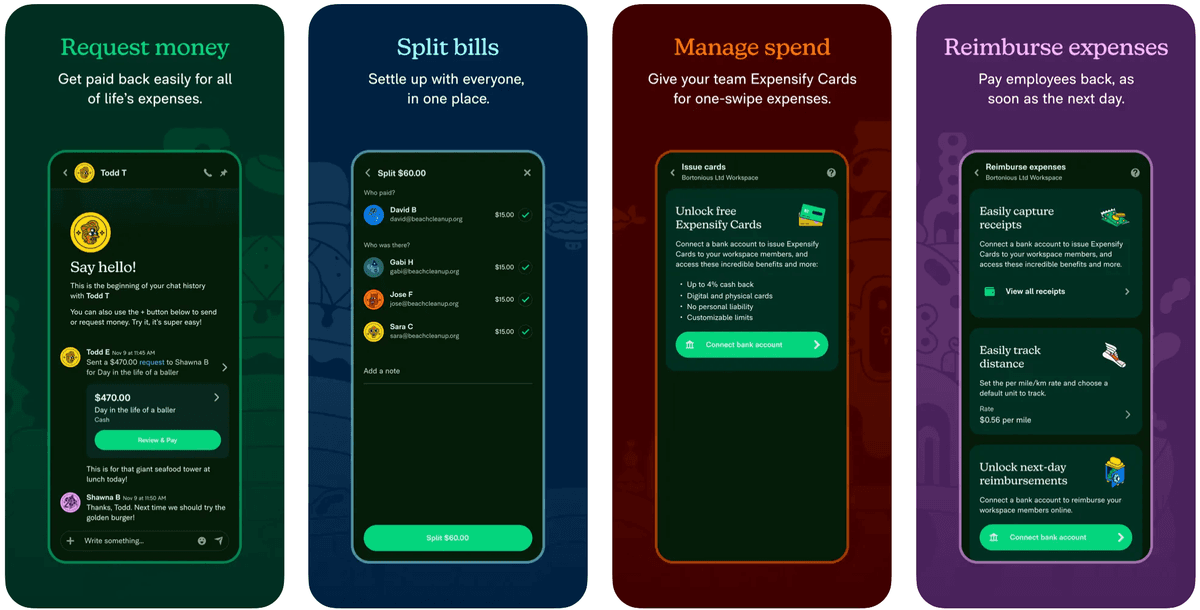
I work as a combined React Native and Python developer — one senior engineer delivering your mobile app and its backend as a single system — with full-product engagements typically running $40K to $200K depending on product surface, AI features, and infrastructure depth. That stack pairing is my core practice: 20+ App Store launches and Guest Engineer work at Expensify on the mobile side, 7+ years of production Python on the backend side, and Top Rated status on Upwork with $100K+ earned and verified client reviews. Most full-stack products reach the app stores in 14 to 20 weeks.
Most products are a mobile app plus a backend, and hiring them as separate specialists means paying an integration tax forever — two engineers negotiating API contracts, blaming each other's layer, and shipping at the speed of their coordination. One senior engineer fluent in both React Native and Python removes that seam, which matters double when the backend includes AI features that need tight iteration with the app experience.
Weekly demos, async Slack updates, production standards.
04
Ship
Store launch, documentation, knowledge transfer.
Engagements this covers
Full product build from one pair of hands
A funded startup needs the whole system — iOS and Android app, Python API, database, deployment — without assembling a team first. I design app and backend as one architecture, evolve the API contract freely as screens take shape, and ship weekly builds spanning the full stack. Outcome shape: a launched product where no requirement was lost in translation between a frontend and backend developer.
Mobile app with AI features that need backend depth
A product's roadmap includes AI — a chat assistant, document understanding, smart search — which demands Python for the pipeline and mobile craft for streaming, latency-masking UX. I build both ends of each feature together, tuning the pipeline and the interaction as one loop. Outcome shape: AI features that feel native to the app rather than a web demo bolted into a WebView.
Two disconnected codebases, one accountable owner
A company has a React Native app from one contractor and a Python backend from another; each blames the other for bugs, and nobody owns the system. I audit both, take ownership of the whole, fix the contract mismatches causing the worst issues, and establish one release process spanning both layers. Outcome shape: a single throat to choke, and bugs fixed in the layer where they actually live.
Why one engineer across both layers changes the economics
Split a product between a mobile contractor and a backend contractor and you buy a permanent coordination cost: API contracts negotiated in tickets, integration bugs that each side attributes to the other, and features that stall because the backend endpoint isn't ready or the app can't consume what shipped. Every cross-layer change — and in a young product most changes are cross-layer — pays this tax. With one engineer owning both, an API change and its consuming screen land in the same working session, and the integration bug category simply disappears; there is no seam to fall into.
The economics follow: you're not paying two part-time seniors to attend each other's standups, and velocity on cross-stack features roughly doubles because negotiation is replaced by decision. The honest limit is bandwidth — one engineer is one engineer, and past a certain product size you need a team. The pattern that works: I build the system to launch and first growth, then help you hire specialists into a codebase with clean seams, docs, and CI already in place, where the boundaries I maintained as one person become the boundaries between your future hires.
Where this pairing especially pays off: AI-backed mobile products
AI features are full-stack by nature. The pipeline — retrieval, model calls, tool use — lives in Python, where the entire AI ecosystem lives. But whether the feature feels magical or broken is decided in the app: streaming tokens rendered smoothly, latency masked with progressive interaction, failures degraded gracefully, costs controlled by what the client actually requests. Building these as separate contracts is miserable, because the right design emerges from iterating both ends together — you adjust the pipeline's response shape and the interaction pattern in the same afternoon, dozens of times, until it feels right.
That iteration loop is where a single engineer across React Native and Python earns the engagement. When a streaming answer stutters, I can determine within the hour whether the cause is chunking on the Python side or rendering on the app side and fix it in the correct layer — a diagnosis that routinely takes two specialist contractors a week of mutual suspicion. If your roadmap includes an assistant, semantic search, document intelligence, or camera-driven AI, hiring the layers together is not a convenience; it's the difference in whether the feature ships feeling native.
How a full-stack engagement is structured
The first two weeks produce a walking skeleton of the entire system: a minimal app installed on your phone, talking to a deployed Python API, through the real auth flow, with CI shipping both layers. This proves the pipeline end to end before feature work starts, and it front-loads the decisions that are expensive to change later — data model, auth approach, deployment shape. From then on, features ship as full vertical slices weekly: screen, API, database, tests, deployed and installable.
Mid-engagement, the backend grows its operational spine — monitoring, staging, background jobs, load validation against your projections — while the app accumulates release infrastructure: crash reporting, analytics, staged rollout config. The final month covers both store submissions and a production hardening pass across the stack. Handover is deliberately dual-track: backend runbooks and API documentation for whoever operates the server side, mobile release documentation and CI ownership for the app side, structured so you can hire one specialist per layer later without either inheriting a mystery.
What drives cost between $40K and $200K
This range covers an entire product — both apps and the backend — so the floor is already a complete system: a focused feature set, standard auth, one database, and straightforward flows lands near $40K–$70K. From there, four drivers move the number. Product surface: more flows and states cost linearly on both layers at once, which is why full-stack scope grows faster than single-layer scope. AI features: each one adds pipeline work, evaluation, and the interaction engineering described above — an assistant or semantic search feature typically adds a five-figure increment alone.
Third, infrastructure depth: offline-first sync, real-time collaboration, or payment processing each add complexity on both sides of the API simultaneously — offline sync in particular is one of the most expensive features in mobile, because it turns the backend into a conflict-resolution system. Fourth, scale and compliance posture: an app launching to a controlled beta needs less hardening than one launching to a marketing push, and regulated data adds audit and access-control work throughout. The $150K–$200K tier is typically a two-sided or AI-centric product with offline capability and payments.
When to hire specialists instead
Be skeptical of full-stack claims in general — the market is full of developers who are strong in one layer and dangerous in the other, and the React Native plus Python combination specifically requires production depth in two ecosystems that rarely co-occur. Verify both halves independently: store launches for the mobile side, operated production systems for the Python side. My own claim rests on checkable evidence — 20+ store launches, Expensify guest engineering, and public Upwork reviews — and that's the standard of proof you should hold anyone to.
And sometimes two specialists genuinely are the right buy: if your backend is deep infrastructure — heavy distributed systems, extreme scale, specialized data engineering — you want a dedicated backend expert, and if your app is a thin client over that infrastructure, a mobile specialist finishing it independently works fine because the seam is narrow and stable. The single-engineer model wins when the product is the integration — when app and backend evolve together weekly. If your API is already stable and versioned, hire the mobile specialist alone and spend the difference elsewhere.
Low-risk to start
✓Fixed-scope proposal first
You approve milestones and a price before any build starts — no open-ended hourly surprises.
✓Working demos every week
You see running software each week, not status reports, so you can course-correct early.
✓One senior owner, no hand-offs
The person who scopes the work is the person who builds it — no junior layers, no agency markup.
✓A track record you can verify
Top Rated on Upwork with public client reviews and $100K+ earned, plus contributions to Expensify. Check the receipts before you commit.
How much does it cost to build an app with backend included?
A complete product — iOS and Android apps plus a Python backend — typically runs $40K to $200K as a single engagement. A focused MVP with standard auth and one database lands at $40K–$70K. AI features, offline-first sync, payments, and two-sided marketplaces each add materially because they cost on both layers at once. This is usually 20–30% below the combined cost of separate mobile and backend contractors, before counting coordination savings.
Should I hire one full-stack developer or separate mobile and backend developers?
One senior engineer across both layers wins when your product is young and the app and API must evolve together — you eliminate integration bugs and contract negotiation entirely, and cross-stack features ship roughly twice as fast. Separate specialists win when the backend is deep infrastructure at serious scale, or when your API is already stable and versioned. The failure mode to avoid is a full-stack generalist who is production-grade in neither layer; verify both halves independently.
How long does it take one developer to build a full app and backend?
Fourteen to twenty weeks to both app stores for a typical product: two weeks for an end-to-end skeleton — app, API, auth, and CI deployed — then weekly vertical slices spanning both layers, and a final month of hardening and store submission. AI features or offline sync extend that. The single-engineer model trades some raw parallelism for zero integration delay, which for most early products nets out faster.
How much does react native python developer typically cost?
Projects typically fall in the $40K–$200K range depending on scope, integrations, and timeline. I provide a fixed-scope proposal after a 30-minute scoping call.
How long does a react native python developer project take?
MVPs often ship in 8–12 weeks. Production systems with AI backends or RAG may run 12–20 weeks. Rescue and audit engagements can start within days.
Do you work with startups and enterprises?
Yes. I work with founders, CTOs, product teams, and agencies worldwide — US, UK, EU, and APAC time zones with async updates and weekly demos.
Can you own mobile and backend together?
Yes. I specialize in React Native + Python (FastAPI) + AI (RAG, agents, OpenAI/Claude) under one senior owner — fewer handoffs, faster shipping.
How do I get started?
Book a free 30-minute scoping call on this site, hire through Upwork, or email dhairyasenjaliya@gmail.com with your brief and timeline.