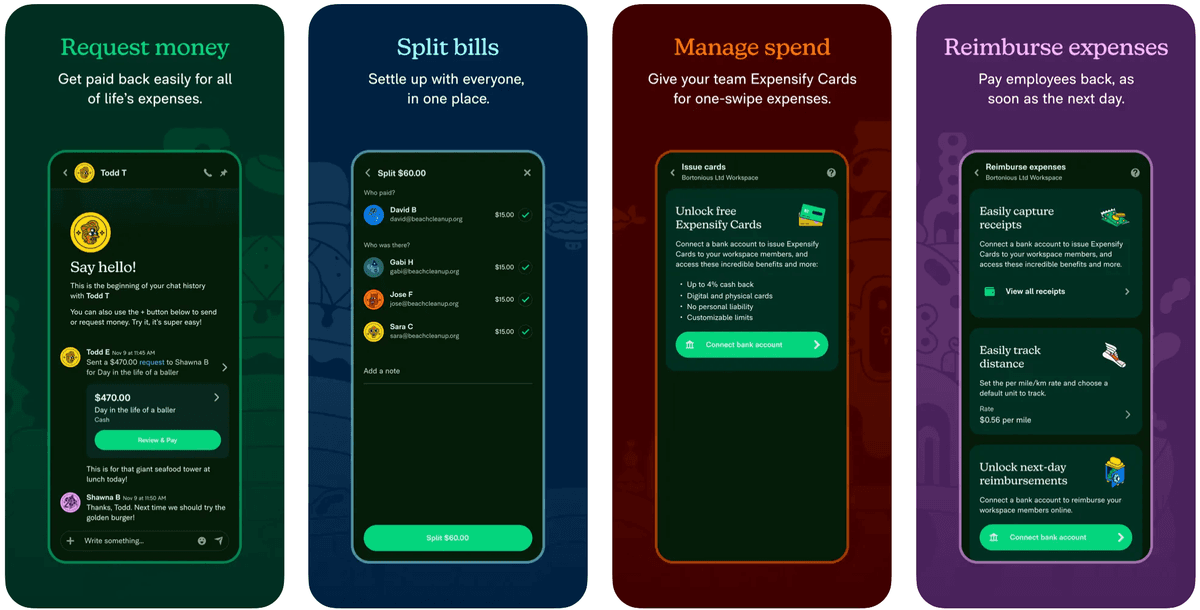
React Native development with me runs $30K–$180K, spanning greenfield builds for both app stores, rescues of struggling codebases, and senior-level augmentation of existing teams. My background is unusually deep for this stack: I was a Guest Engineer at Expensify, whose expense platform serves millions of users from a React Native codebase, and I've shipped 20+ App Store launches over 7+ years of production delivery. I'm Top Rated on Upwork with $100K+ earned and verified client reviews, though Upwork is just one verification channel — much of my work comes from direct clients worldwide. Engagements start with a scoping conversation — or, for existing apps, a short diagnostic — that becomes a fixed, milestone-based plan.
React Native is how one senior engineer ships to both app stores without doubling the budget — when it's used well. This page covers what React Native development costs, the difference between a codebase that lasts and one you'll quietly rewrite, and how to evaluate anyone selling this service.
Weekly demos, async Slack updates, production standards.
04
Ship
Store launch, documentation, knowledge transfer.
Engagements this covers
Greenfield app for both stores
A company needs iOS and Android but has budget and appetite for one team, not two. I build a single React Native codebase with a shared design system, platform-correct navigation and gestures on each OS, and a CI pipeline shipping weekly TestFlight and Play builds. Launch means two store listings, one codebase, and a maintenance surface half the size of parallel native apps.
Performance rescue of an existing app
An app built fast by a previous team now starts slowly, drops frames on every list, and bleeds one-star reviews. I profile before touching anything — startup traces, render counts, memory — then fix the actual causes: list virtualization, re-render storms, oversized JS bundles, misused native bridges. The work ends with measured before-and-after numbers, not adjectives.
Unblocking a team on native code
A capable JavaScript team is stuck at the native boundary: a Bluetooth integration, a payment SDK, background processing, or a New Architecture migration nobody wants to touch. I build the native modules, wire them into TypeScript with clean APIs, and document the pattern so the team can extend it themselves. The team stays; the blocker goes.
What an engagement looks like, week by week
Greenfield engagements start with two weeks of architecture and product surgery: cutting scope, choosing the navigation and state approach, standing up CI, and shipping a walking skeleton to TestFlight — a nearly empty app that already builds, signs, and installs, because release plumbing causes more launch delays than features do. Weeks three through ten are feature slices, each landing in a weekly build you can put on your own phone. The final weeks are hardening: performance passes, accessibility, store-listing assets, and review submission for both stores.
Rescue engagements invert this: week one is a diagnostic — profiling, dependency audit, crash data review — that produces a written findings list ranked by user impact and cost to fix. You can take that document to any developer. Most clients have me execute the top of the list, and we re-measure after each fix so progress is numeric rather than anecdotal.
What moves the price inside $30K–$180K
Feature surface is the obvious driver, but the expensive ones hide elsewhere. Whether a backend exists matters enormously: consuming your existing API keeps a project near the bottom of the range, while building the API, auth, and data model alongside the app — which I do in Python — can add half again. Native-boundary work is the next multiplier: camera pipelines, Bluetooth hardware, offline sync, background location, and payment SDKs each add native code on two platforms plus the testing that goes with it.
Design maturity matters more than buyers expect — a finished design system saves weeks, while figuring out screens as we go bills them. Real-time features, complex animation, and deep offline support each move the number meaningfully. What doesn't move it as much as people fear is the second platform: shipping Android alongside iOS from one React Native codebase typically adds a small fraction, not a second budget — and that arithmetic is most of the reason this stack exists.
Red flags when buying React Native development
The loudest red flag is a portfolio with no installable apps. Store launches are public and permanent; screenshots and case-study PDFs are neither. Ask for links, install the apps, and feel the scroll performance yourself.
Others worth taking seriously: web agencies selling React Native on the theory that React developers can do mobile — the language is shared, the discipline isn't, and the gap shows up in gestures, navigation, and everything at the native boundary; nobody on the team who can write Swift or Kotlin when a module demands it, which means your hard problems get workarounds instead of solutions; no opinion on the New Architecture or an upgrade story, leaving you stranded on old versions; a quote that arrives with no questions about your backend; and pricing that only works if juniors do the building. React Native's reputation problems are mostly these vendors' output. The stack itself is fine — Expensify runs on it at the scale of millions — but it rewards seniority and punishes tourists.
How to evaluate any React Native developer
Ask when they would not use React Native. This is the single best filter question: honest answers exist — heavy 3D, hardware-first products with deeply divergent platform UX, teams already strong in Swift and Kotlin with no cross-platform pressure — and a vendor who claims the stack fits everything is selling their staffing model, not advice. Then ask about the worst performance bug they've fixed; engineers who have genuinely shipped will tell you a specific, slightly painful story with numbers in it.
On verification: install their launched apps — mine number 20+ across 7+ years of production delivery — and check reviews on a channel that verifies payment happened, which is what my Top Rated Upwork profile with verified client reviews is for, even though most of my engagements now come direct. Finally, ask who actually writes the code. With me the answer is me; with an agency, insist on meeting the real engineers before signing, not after.
What good delivery looks like
You own the repositories, the Apple and Google developer accounts, and the signing credentials from day one — I work inside your accounts, so handover is a permissions change, not a negotiation. From the second or third week, a weekly build lands on your phone; if a vendor can't show working software until the end, the risk is pooling silently.
At handover, good delivery means a typed TypeScript codebase a new senior hire can navigate without me; CI that produces signed, store-ready builds automatically; crash reporting and analytics wired in, with a crash-free-session target agreed before launch; documentation of the decisions that will bite later — why this navigation library, where the native boundaries sit, how to upgrade React Native versions; and a final week where your team or my successor ships a small change with me reviewing. The real test of my work isn't the launch — it's whether the codebase is still upgradeable and pleasant to work in eighteen months later.
When React Native is the wrong buy
I sell React Native development and I will still tell you when not to buy it. Skip it for graphics-heavy games and 3D- or AR-first products — game engines and native frameworks own that ground. Skip it if your product's core value is deep platform integration with meaningfully different UX per OS, where the shared-code dividend evaporates. And if you already employ strong Swift and Kotlin teams shipping happily, introducing a third stack creates a political problem, not a technical solution.
Also skip the custom build entirely if you're pre-validation: a landing page, a no-code prototype, or a concierge test answers whether anyone wants this far more cheaply than any codebase. React Native's sweet spot is specific and large — a product-driven app that needs to exist credibly on both stores, built and maintained by a small senior team, evolving weekly. That describes most startup and mid-market mobile products, which is why I've spent 7+ years here. It just doesn't describe everything.
Low-risk to start
✓Fixed-scope proposal first
You approve milestones and a price before any build starts — no open-ended hourly surprises.
✓Working demos every week
You see running software each week, not status reports, so you can course-correct early.
✓One senior owner, no hand-offs
The person who scopes the work is the person who builds it — no junior layers, no agency markup.
✓A track record you can verify
Top Rated on Upwork with public client reviews and $100K+ earned, plus contributions to Expensify. Check the receipts before you commit.
Is React Native production-grade, or will we end up rewriting natively?
It's production-grade when built by people who understand the native layer underneath it. Expensify serves millions of users from a React Native codebase — I've worked inside it as a Guest Engineer — and the platform's failures in the wild are usually vendor failures: web teams shipping their first mobile app. The rewrite risk is real only when a codebase strands on old versions with tangled native patches, which is exactly what disciplined architecture and a maintained upgrade path prevent.
Can you take over an existing React Native codebase?
Yes — takeovers and rescues are a large share of my work. I start with a short diagnostic: profiling, a dependency and upgrade audit, crash data, and a read of the architecture, producing a written findings list ranked by user impact and cost to fix. That document is yours regardless of what happens next. Some codebases need surgery, a few genuinely need restarting, and I'll tell you which yours is with evidence rather than instinct.
How long does a React Native app take to build?
A focused v1 typically takes three to five months from kickoff to both stores; larger products with custom backends run longer. You'll see a working build in the first two to three weeks and weekly builds after that, so the schedule is observable rather than promised. The recurring schedule killers aren't code — they're unfinished designs, late API dependencies, and store review cycles, all of which I front-load or plan around explicitly.
How much does react native development services typically cost?
Projects typically fall in the $30K–$180K range depending on scope, integrations, and timeline. I provide a fixed-scope proposal after a 30-minute scoping call.
How long does a react native development services project take?
MVPs often ship in 8–12 weeks. Production systems with AI backends or RAG may run 12–20 weeks. Rescue and audit engagements can start within days.
Do you work with startups and enterprises?
Yes. I work with founders, CTOs, product teams, and agencies worldwide — US, UK, EU, and APAC time zones with async updates and weekly demos.
Can you own mobile and backend together?
Yes. I specialize in React Native + Python (FastAPI) + AI (RAG, agents, OpenAI/Claude) under one senior owner — fewer handoffs, faster shipping.
How do I get started?
Book a free 30-minute scoping call on this site, hire through Upwork, or email dhairyasenjaliya@gmail.com with your brief and timeline.