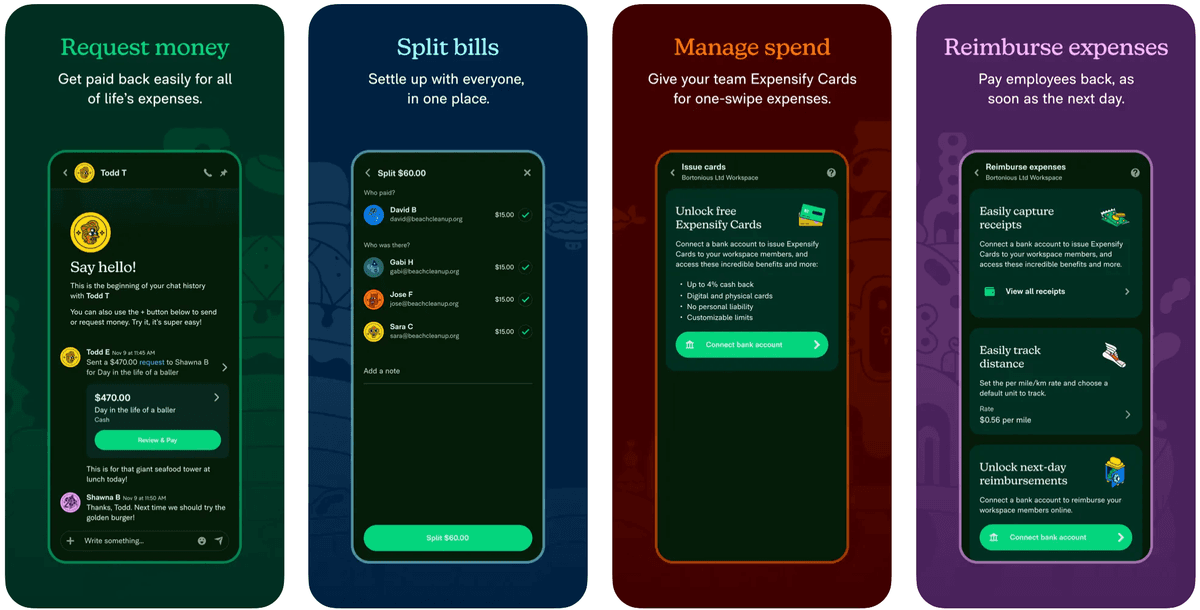
Hiring me as a React Native freelancer runs $15K–$100K per engagement: focused feature work, performance rescues, or upgrade projects at the lower end, and full app builds from design to both app stores at the upper end. I've specialized in React Native for 7+ years with 20+ App Store launches, shipped as a Guest Engineer at Expensify on an app used by millions, and I'm Top Rated on Upwork with $100K+ earned and verified client reviews. Engagements start with a scoped written proposal, and most clients are working with me inside two weeks of first contact.
The React Native freelance market has a variance problem: rates spanning 10x, portfolios that can't be verified, and a technology where the gap between 'renders on my phone' and 'ships reliably to both stores' swallows entire projects. This page covers how I work and what I cost — and how to evaluate any React Native freelancer, including me, before money moves. The hiring decision is where most project outcomes are actually determined.
Weekly demos, async Slack updates, production standards.
04
Ship
Store launch, documentation, knowledge transfer.
Engagements this covers
Full app build, design to stores
A founder or small company has designs and a validated idea but no mobile team. I build the app in React Native — architecture, implementation, native modules where needed, store submission for iOS and Android — with weekly builds they can hold from week two. They launch with one accountable engineer instead of coordinating an agency's rotating cast.
Senior reinforcement for an existing team
A team with web-strong React developers is struggling with the native side — build failures, upgrade paralysis, a flaky release pipeline, performance nobody can diagnose. I embed part-time, unblock the native-layer problems, fix the CI/CD and release process, and level the team up through review and pairing. The team keeps shipping while their hardest problems stop recurring.
Rescue of a stalled or inherited codebase
A company inherited a React Native app from a departed contractor or failed agency: it barely builds, dependencies are years stale, and the store listing is at risk. I stabilize the build, execute the upgrade path, triage the codebase into keep/fix/rewrite, and re-establish releases. The app returns to shippable, and the company regains the ability to plan around it.
How an engagement with me works
It starts with a short call and, for existing codebases, a look at the code before I quote — I don't price unseen work, and you should distrust anyone who does. You get a written proposal: scope, milestones, timeline, price, and explicitly what's out of scope, which prevents the ambiguity that sours freelance engagements.
Delivery is visibility-first: a build on your phone by the second week via TestFlight and internal testing tracks, updated continuously after that. You see progress by using the app, not by reading status reports. Communication is async-first with a weekly call if you want one; you always know what shipped, what's next, and what's blocking. Code lives in your repository from day one — you own everything continuously, and if we part ways mid-project for any reason, you hold working, documented code, not hostage material. Handoff includes store credentials hygiene, release runbooks, and a walkthrough for whoever maintains the app next.
What $15K–$100K buys at different points in the range
At $15K–$30K: a substantial focused project — a performance rescue with measured before/after numbers, a React Native version upgrade with native module remediation, a complex feature built into your existing app, or an MVP with genuinely tight scope. At $30K–$60K: a complete production app of moderate complexity — accounts, payments, push notifications, offline behavior, analytics, both stores — built solo and accountable end to end.
At $60K–$100K: apps with hard problems — custom native modules on both platforms, real-time features, deep third-party integrations, or backend work bundled in — or longer embedded engagements where I function as your senior mobile engineer for several months. What moves cost within any tier: how much design exists (missing design becomes my time), integration count, native-layer depth, and offline requirements, which quietly double state-management complexity. A note on rate math: senior freelancers cost more per hour than juniors and routinely less per shipped outcome — the expensive part of cheap engineers is the rework.
How to vet any React Native freelancer
Verify shipped apps, not screenshots: ask for App Store and Play Store links, then check the review history and update cadence — a real production app has both. Ask who else worked on those apps; solo-shipped versus contributed-to matters and candidates blur it. Check for platform-verified track records (marketplace ratings with earnings history are hard to fake; portfolio sites are easy) and ask for one reference from a project that hit trouble, because how a freelancer handles a rough project tells you more than three smooth ones.
Then test judgment with two questions. 'When would you tell me not to use React Native?' — anyone without a real answer is a hammer looking for nails. 'Walk me through your last painful native-layer bug' — React Native's failure modes live at the native boundary, and engineers who've only worked in the JavaScript layer can't rescue you there. Finally, insist on the trial-milestone pattern: a small first deliverable, paid, before either side commits to the full engagement.
Freelancer versus agency versus hiring
An agency gives you process, redundancy, and a project manager — priced in, typically at 2–3x a senior freelancer's cost for the same build, and the engineers actually writing your code are often more junior than the people who pitched you. A full-time hire is the right call when mobile is your core product and there's durable work beyond the first build; expect months to recruit at senior market salaries, and be honest about whether you have enough mobile work to keep them growing.
A senior freelancer is the efficient middle for a defined build, a rescue, or fractional senior capacity alongside an existing team: you get the person you evaluated, no telephone game, and accountability concentrated in one individual. The honest trade-off is bus factor — mitigate it by requiring continuous code ownership in your repo, documentation as a deliverable, and handoff support in the contract. I structure engagements that way by default, partly because it also keeps me honest.
When I'm the wrong hire
If your app needs a large team moving in parallel — a dozen screens a sprint across multiple squads — you need an agency or in-house team, not a soloist, and pretending otherwise just makes me your bottleneck. If your product is a game, heavy AR, or something that lives and dies on bleeding-edge native APIs, hire native specialists; React Native is the wrong substrate and I'll tell you so in the first call.
If your budget is a few thousand dollars, the honest options are no-code tools or a very tightly scoped prototype — not a discounted version of a production build, which is how projects end up abandoned at 80%. And if what you really want is a body to type out decisions you've already made in detail, a mid-level contractor at half my rate serves you better; my value is concentrated in the judgment, the native-layer depth, and the shipping discipline. When those match your problem, the engagement pays for itself; when they don't, I'd rather point you to the right resource.
Low-risk to start
✓Fixed-scope proposal first
You approve milestones and a price before any build starts — no open-ended hourly surprises.
✓Working demos every week
You see running software each week, not status reports, so you can course-correct early.
✓One senior owner, no hand-offs
The person who scopes the work is the person who builds it — no junior layers, no agency markup.
✓A track record you can verify
Top Rated on Upwork with public client reviews and $100K+ earned, plus contributions to Expensify. Check the receipts before you commit.
How much does it cost to hire a React Native freelancer?
Senior React Native freelancers typically bill $70–$150 per hour, with project engagements from $15K for substantial focused work — an upgrade, rescue, or major feature — to $30K–$60K for a complete production app, and up to $100K for complex builds with custom native work. Cheaper options exist and often cost more per shipped outcome: the most expensive React Native projects are the ones built twice.
How do I verify a React Native freelancer is actually good?
Demand store links to shipped apps and check their update history and reviews — production apps leave public trails. Prefer platform-verified track records (Upwork earnings and client reviews are hard to fake) over portfolio sites. Ask about native-layer debugging experience specifically, since that's where React Native projects actually fail. Then structure a paid trial milestone of one to two weeks before committing the full project; it's the cheapest vetting tool that exists.
Should I hire a freelancer or an agency to build my React Native app?
For a defined app build, a senior freelancer typically delivers the same outcome at a third to half of agency cost, with the advantage that the person you vetted writes the code. Agencies earn their premium when you need many engineers in parallel, guaranteed continuity, or ongoing capacity beyond one person. Whichever you choose, require code in your repository from day one and documentation as a contractual deliverable, not a courtesy.
How much does react native freelancer typically cost?
Projects typically fall in the $15K–$100K range depending on scope, integrations, and timeline. I provide a fixed-scope proposal after a 30-minute scoping call.
How long does a react native freelancer project take?
MVPs often ship in 8–12 weeks. Production systems with AI backends or RAG may run 12–20 weeks. Rescue and audit engagements can start within days.
Do you work with startups and enterprises?
Yes. I work with founders, CTOs, product teams, and agencies worldwide — US, UK, EU, and APAC time zones with async updates and weekly demos.
Can you own mobile and backend together?
Yes. I specialize in React Native + Python (FastAPI) + AI (RAG, agents, OpenAI/Claude) under one senior owner — fewer handoffs, faster shipping.
How do I get started?
Book a free 30-minute scoping call on this site, hire through Upwork, or email dhairyasenjaliya@gmail.com with your brief and timeline.