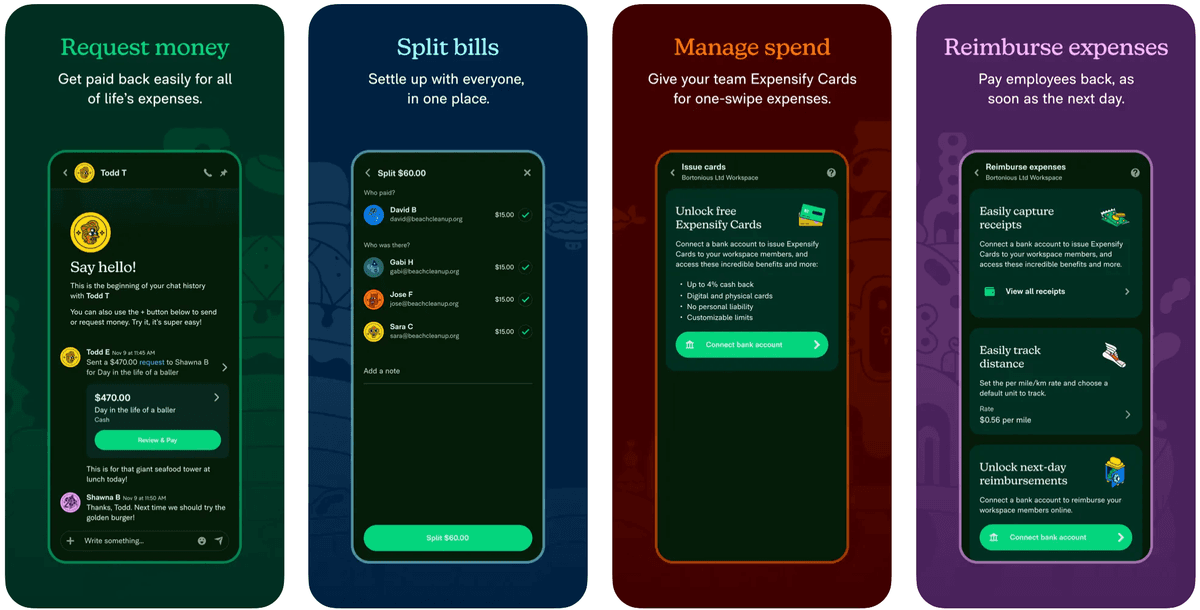
You can hire me for Node.js development on a project or retainer basis, with typical engagements running $15K to $90K depending on whether it's a focused API build, a full backend with integrations, or a rescue of an existing system. I've spent 7+ years delivering production systems — including as a Guest Engineer at Expensify, whose platform serves millions of users — and I'm Top Rated on Upwork with $100K+ earned and verified client reviews. Most API projects ship a usable first version within 4 to 6 weeks, with the balance of the engagement going to integrations, hardening, and load validation.
Node.js backends power most of the products I'm hired to build mobile apps against, and the quality gap between Node codebases is wider than in any other ecosystem — the same framework serves weekend projects and platforms handling millions of users. Buying Node development well means buying the discipline around the code: typed contracts, tests, observability, and deployment your team can operate without the person who built it.
Weekly demos, async Slack updates, production standards.
04
Ship
Store launch, documentation, knowledge transfer.
Engagements this covers
API backend for a new product
A funded startup needs the backend for its app: auth, core domain logic, payments, push notifications, and admin endpoints. I design the API contract first so mobile and backend work can proceed in parallel, build in TypeScript with a test suite, and deploy with CI, staging, and monitoring. Outcome shape: a backend the first in-house hire can extend, not decipher.
Express backend drowning under growth
A product's Node API was built fast by a generalist and now falls over at peak traffic — slow endpoints, memory creep, and one giant file nobody wants to touch. I profile before changing anything, fix the handful of endpoints causing most of the pain, add caching and connection pooling, and restructure incrementally. Outcome shape: stable latency at current traffic with headroom measured, not guessed.
Third-party integration layer
A company needs its systems talking to external services — payment providers, logistics APIs, a CRM — with retries, webhooks, and reconciliation handled properly. I build an integration service with idempotent processing, dead-letter handling for failures, and dashboards showing sync health. Outcome shape: integrations that fail loudly and recover automatically instead of silently dropping records.
What a Node.js engagement looks like in practice
Week one produces two artifacts: an API contract and a walking skeleton. The contract — typed schemas for every endpoint we've scoped — lets frontend or mobile work start immediately against a mock, which is usually worth two to three weeks of calendar time on a product build. The walking skeleton is a deployed hello-world with CI, environments, and monitoring already wired, because retrofitting deployment discipline at week eight is where projects go sideways.
From there, the build proceeds in vertical slices: each week ships complete features — endpoint, business logic, persistence, tests — rather than horizontal layers that only integrate at the end. You see working software weekly and can reprioritize between slices. The final phase before handover is load validation against your realistic traffic projections and a failure drill: we deliberately kill dependencies in staging and confirm the system degrades the way we designed it to. Handover includes runbooks and a working session with whoever operates it next.
What you're actually paying for across $15K to $90K
A single focused service — one API, one database, standard auth, clean requirements — is the $15K–$30K tier, and most of that budget is business logic and testing rather than infrastructure. The middle of the range is where most product backends live: multiple integrations, background job processing, role-based permissions, file handling, and the operational build-out of staging, monitoring, and alerting.
The top of the range is earned by three things. Real-time features — live updates, chat, presence — add stateful infrastructure that's an order of magnitude harder to operate than request-response. High-consequence domains like payments and financial records demand idempotency, reconciliation, and audit trails throughout, which roughly doubles the care per endpoint. And rescue work on existing systems prices by risk: changing a live backend serving real traffic without breaking it requires characterization tests and incremental migration that greenfield work skips. What does not drive price much is endpoint count — fifty simple CRUD endpoints cost less than five that encode genuinely tricky domain rules.
How to tell senior Node work from fast Node work
Node's low barrier to entry means the market is full of developers who can produce a working API quickly, and the differences only surface months later. There are concrete things to check. TypeScript with strict settings, not JavaScript with types sprinkled on — untyped Node backends become unrefactorable at exactly the moment you need to change them fast. Validation at every boundary, because Node will happily pass malformed data all the way to your database. Structured error handling with a story for what happens when a downstream service times out — the default answer in rushed Node code is an unhandled rejection and a crashed process.
Ask any candidate how they'd find a memory leak in production, how they handle a slow third-party API without letting it stall the event loop, and what their migration strategy is for schema changes on a live database. These aren't trivia — they're the three problems every production Node system eventually has. Fluent, specific answers mean they've been on call for their own code. Vague ones mean you'll be their learning experience.
Common mistakes companies make buying backend work
The most expensive mistake is buying features without buying operability. A backend that works but has no staging environment, no structured logs, and no alerting is a system where every incident is a fire drill and every deploy is a bet. When comparing quotes, check whether deployment, monitoring, and documentation are in scope — a bid that's 30% cheaper usually got there by cutting exactly those things, and you'll pay more than the difference to add them later.
The second mistake is skipping the API contract phase to start faster. Without an agreed contract, the frontend team builds against assumptions, and integration week becomes integration month. The third is over-buying architecture: microservices for a product with a thousand users, event sourcing because a blog post recommended it, Kubernetes for something a managed platform runs fine. Complexity is a cost you pay monthly in operations, forever. A well-structured monolith with clean module boundaries is the right call for most products below serious scale, and it's what I'll recommend unless your load profile says otherwise.
When Node.js is the wrong tool
Node excels at I/O-heavy workloads — APIs orchestrating databases and external services, real-time messaging, high-concurrency request handling. It's the wrong default for CPU-heavy work: heavy data processing, media transcoding, scientific computation, or anything ML-related will block Node's single-threaded event loop and belongs in Python or a compiled language, with Node calling it as a service if needed. I work in both Node and Python daily, so my recommendation follows the workload rather than my comfort zone.
The other wrong reason to choose Node is team mismatch. If your existing engineers live in Python or another ecosystem and will inherit this system, a Node codebase becomes an orphan the day I leave, however clean it is. Continuity beats marginal technical fit. Where Node is unambiguously right: your team already knows JavaScript, you want one language across web frontend and backend, or you're building the API layer for a React Native app — which is exactly where most of my Node engagements come from.
Low-risk to start
✓Fixed-scope proposal first
You approve milestones and a price before any build starts — no open-ended hourly surprises.
✓Working demos every week
You see running software each week, not status reports, so you can course-correct early.
✓One senior owner, no hand-offs
The person who scopes the work is the person who builds it — no junior layers, no agency markup.
✓A track record you can verify
Top Rated on Upwork with public client reviews and $100K+ earned, plus contributions to Expensify. Check the receipts before you commit.
How much does it cost to hire a Node.js developer for a project?
Project-based Node.js engagements typically run $15K to $90K. A focused single-purpose API lands at $15K–$30K; a full product backend with integrations, background jobs, and proper deployment infrastructure sits in the middle; real-time features, payment-grade reliability, or rescue work on live systems reach the top. Hourly senior rates make fixed-scope projects more predictable for most buyers than open-ended time-and-materials.
How long does it take to build a Node.js backend for an app?
A production API for a typical app takes four to ten weeks. You should see an agreed API contract and a deployed skeleton in week one — which unblocks frontend work immediately — and complete features shipping weekly after that. Integrations with third-party services are the most common source of delay, so surface every external dependency during scoping to keep the estimate honest.
Should I use Node.js or Python for my backend?
Choose by workload and team. Node.js wins for I/O-heavy APIs, real-time features, and teams already fluent in JavaScript or TypeScript. Python wins the moment AI, ML, or heavy data processing enters the picture, and its ecosystem there has no Node equivalent. Many products I build use both — a Node or Python API with the other handling specialized services. Whoever maintains the system long-term should tip close calls.
How much does node.js development services typically cost?
Projects typically fall in the $15K–$90K range depending on scope, integrations, and timeline. I provide a fixed-scope proposal after a 30-minute scoping call.
How long does a node.js development services project take?
MVPs often ship in 8–12 weeks. Production systems with AI backends or RAG may run 12–20 weeks. Rescue and audit engagements can start within days.
Do you work with startups and enterprises?
Yes. I work with founders, CTOs, product teams, and agencies worldwide — US, UK, EU, and APAC time zones with async updates and weekly demos.
Can you own mobile and backend together?
Yes. I specialize in React Native + Python (FastAPI) + AI (RAG, agents, OpenAI/Claude) under one senior owner — fewer handoffs, faster shipping.
How do I get started?
Book a free 30-minute scoping call on this site, hire through Upwork, or email dhairyasenjaliya@gmail.com with your brief and timeline.