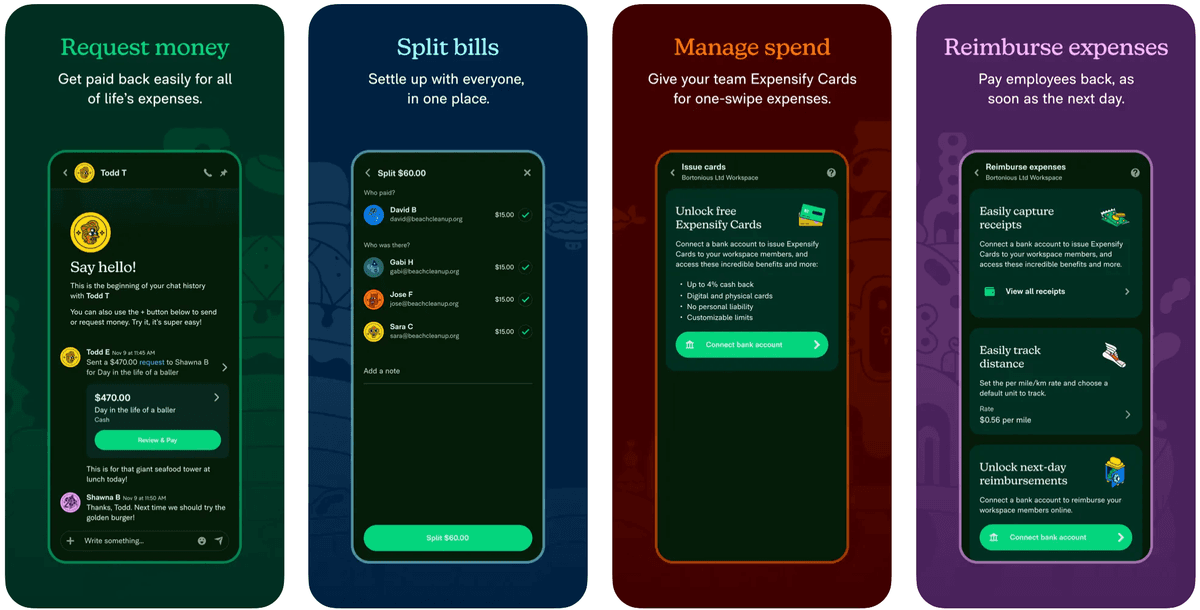
MVP development with me runs $15K–$75K: the low end buys a tightly scoped single-platform app on managed backend services, the high end a both-platform launch with custom backend, payments, and post-launch iteration. In 7+ years of production delivery I've shipped 20+ App Store launches and worked as a Guest Engineer at Expensify, an expense platform used by millions — so your MVP is built by someone who has carried products well past the MVP stage. I'm Top Rated on Upwork with $100K+ earned and verified client reviews if you want independent verification, though most founders contract with me directly. Every engagement starts with a scope-cutting workshop, because the cheapest feature is the one we agree not to build.
An MVP has one job: answer a specific question about your business — will people sign up, pay, come back — at the lowest cost that produces a trustworthy answer. This page explains how I build MVPs that do that job, what drives the price, and the cases where you shouldn't build an app at all yet.
Weekly demos, async Slack updates, production standards.
04
Ship
Store launch, documentation, knowledge transfer.
Engagements this covers
Booking marketplace for a non-technical founder
A founder had a validated waitlist for a local-services marketplace and no technical team. We cut her feature list from thirty items to nine in the first workshop, built the booking and payment flow on a managed backend, and launched on iOS and Android in ten weeks. Analytics were wired to her one validation question — repeat bookings — and the answer arrived within the first month.
Investor-demo build for a funded startup
A pre-seed team needed a working product before their next raise. Instead of a thin slice of everything, we shipped one flow end to end — onboarding to core action to shareable result — polished enough to feel real in an investor's hands. The rest stayed as honest roadmap slides. They closed the round, and the demo app became the foundation of v1 rather than throwaway code.
Internal-tool pilot for a corporate innovation team
An operations group wanted to test whether field staff would adopt a mobile inspection workflow before requesting real budget. I built a focused app distributed through TestFlight and internal Android tracks, with adoption metrics defined before development started. Sixty days of pilot data gave the team a clear yes, and the funded rebuild started from a proven design instead of a hypothesis.
How an MVP engagement runs, week by week
Week one is a scope-cutting workshop, and it's where most of the value hides. We name the single question your MVP must answer, sort every feature into launch, later, or never, and define the metric that decides success. Founders usually arrive with three products' worth of features; leaving with one product's worth is the deliverable.
Weeks two through eight are the build, delivered as weekly installable demos — you hold the real app on your phone every Friday, which surfaces wrong assumptions while they're still cheap to fix. Store submission starts around week eight rather than at the end, because review can take iterations and shouldn't gate your launch date. The final stretch wires analytics to your validation metric, sets up crash reporting, and hands over documentation. Six to twelve weeks covers most MVPs; payments, marketplaces with two user types, and both-platform launches sit at the longer end.
What moves the cost inside $15K–$75K
The low end assumes one platform, a managed backend like Firebase or Supabase, standard authentication, and a design built from proven patterns rather than custom art direction. That combination ships a real, store-approved product capable of validating most consumer and B2B ideas.
Four things push toward the high end. Custom backend work — when your logic can't live in managed services, someone has to design, build, and host an API, and that's often a third of total cost. Payments and marketplaces — charging money adds compliance, edge cases, and payout flows, and two-sided products effectively double the surface area. Real-time features — chat, live tracking, and collaborative state are disproportionately expensive relative to how easy they are to sketch on a whiteboard. And both platforms at launch — React Native makes the second platform cheap, but not free, once platform-specific testing and store processes are counted. In the workshop we price these levers explicitly, so you trade scope against budget deliberately.
Red flags when buying MVP development
The biggest red flag is a vendor who accepts your entire feature list without argument. An MVP builder's first job is subtraction; someone who quotes happily on thirty features either doesn't understand validation or is billing by the feature. Closely related: a detailed fixed price against a vague specification — one of those two documents is fiction.
Other warning signs: no discussion of what happens after launch, as if shipping were the finish line rather than the starting gun. No questions about your validation metric or your users. Agencies quoting senior rates while juniors do the work — ask directly who writes the code. Portfolio apps that no longer exist in the stores, which often means they never truly launched or died immediately. And timelines under four weeks for anything involving accounts, payments, or store review: those builds exist, but they're demos wearing an MVP costume, and you'll rebuild from scratch afterward.
How to evaluate an MVP vendor
Download their shipped apps — the actual store listings, not screenshots — and judge onboarding quality, stability, and polish, because that's the ceiling of what you'll get. Then talk to two past founder clients and ask what broke after launch and how the vendor responded; post-launch behavior separates builders from invoice factories.
In the sales conversation, run one test: describe your full vision and watch whether they push back. A good vendor should try to shrink your first release and should articulate which features can wait and why. Ask what they would cut. Ask who personally writes the code and whether you can speak with that person. Ask where the code lives during development — the only acceptable answer is your repository and your accounts, from day one. Finally, compare quotes on identical scope: a bid at half the price of the others usually omits the boring essentials — error states, store compliance, analytics — that decide whether your launch produces usable answers.
What good MVP delivery looks like
The app is live in the stores under your developer accounts, the code is in your repository, and every third-party service — backend, analytics, crash reporting, payments — is contracted in your name. There is no moment where you have to ask permission to access your own product.
Beyond ownership, three tests. First, the analytics answer your validation question from day one: you can see activation, retention, and your core metric without commissioning more work. Second, the codebase survives your next hire — sensible structure, current dependencies, a README that gets a new developer running in an hour — because a validated MVP immediately becomes v1, and "throwaway MVP code" is a myth that costs founders their momentum exactly when it matters most. Third, the crash rate is boring: an MVP validates nothing if the users you finally attracted meet a product that falls over. Good delivery makes the next decision — invest, pivot, or stop — obvious from the data.
When you should not build an MVP yet
If you can test your riskiest assumption without software, do that first. A landing page with a waitlist tests demand for a fraction of this budget; a concierge test — delivering the service manually over chat and spreadsheets — tests the workflow itself. I've told founders to go do exactly that and come back later; several did, with sharper scope and better odds.
Hold off, too, if you can't state the one question the MVP must answer — "we'll see how it goes" is how a serious budget produces no decision. If your runway can't survive two or three months of post-launch iteration, wait until it can: launch is where the learning starts, and an MVP you can't afford to iterate on is a monument, not an experiment. And if what you actually need is a pitch demo for one meeting, say so — a clickable prototype costs a tenth as much, and I'd rather build you the right thing.
Low-risk to start
✓Fixed-scope proposal first
You approve milestones and a price before any build starts — no open-ended hourly surprises.
✓Working demos every week
You see running software each week, not status reports, so you can course-correct early.
✓One senior owner, no hand-offs
The person who scopes the work is the person who builds it — no junior layers, no agency markup.
✓A track record you can verify
Top Rated on Upwork with public client reviews and $100K+ earned, plus contributions to Expensify. Check the receipts before you commit.
Six to twelve weeks from workshop to store availability for most scopes. Single-platform apps on managed backends land near six; marketplaces, payments, or both-platform launches push toward twelve. Apple's review adds days to a couple of weeks and occasionally demands changes, which is why I submit early rather than at the end. Anyone quoting under a month for a full account-based product is describing a demo, not a launch.
Do I own the code and the app store accounts?
Yes, entirely, from day one — not after final payment. The repository is created under your organization, the App Store and Play Console accounts are yours, and every service is signed up in your name with me added as a collaborator. If we part ways mid-project, you lose nothing but momentum. Vendors who keep code in their own accounts "for convenience" are building leverage, not software, and it's the first thing I'd tell you to negotiate away.
What happens after launch?
Three honest options. I stay on a part-time retainer to iterate on what the data shows — the most common path for the first few months. Or I hand over to your first engineering hire, with documentation written for exactly that purpose and a paid overlap period if you want one. Or you pause and decide later; the codebase and docs are built so that returning after a gap stays cheap. No lock-in is engineered into any of these.
How much does mvp development services typically cost?
Projects typically fall in the $15K–$75K range depending on scope, integrations, and timeline. I provide a fixed-scope proposal after a 30-minute scoping call.
How long does a mvp development services project take?
MVPs often ship in 8–12 weeks. Production systems with AI backends or RAG may run 12–20 weeks. Rescue and audit engagements can start within days.
Do you work with startups and enterprises?
Yes. I work with founders, CTOs, product teams, and agencies worldwide — US, UK, EU, and APAC time zones with async updates and weekly demos.
Can you own mobile and backend together?
Yes. I specialize in React Native + Python (FastAPI) + AI (RAG, agents, OpenAI/Claude) under one senior owner — fewer handoffs, faster shipping.
How do I get started?
Book a free 30-minute scoping call on this site, hire through Upwork, or email dhairyasenjaliya@gmail.com with your brief and timeline.