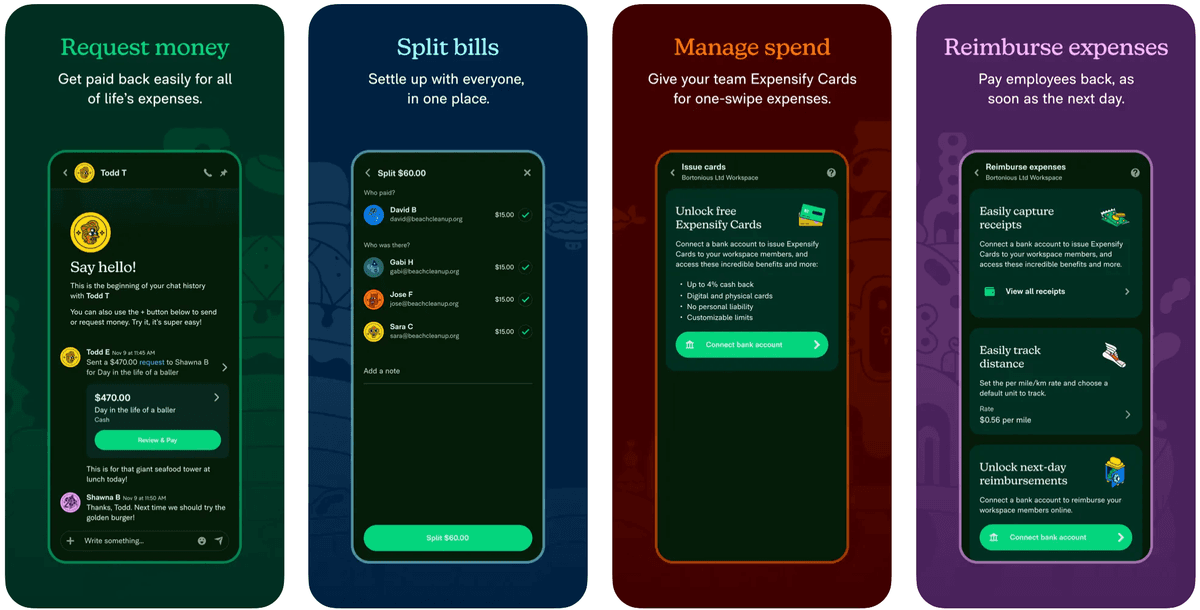
Fintech app development with me runs $50K–$250K, with the price driven by how many money-movement flows you need, your KYC and compliance surface, and whether a banking partner provides the ledger or we build one. I was a Guest Engineer at Expensify — an expense platform used by millions — and I've shipped 20+ App Store launches over 7+ years of production delivery. You can verify my track record on Upwork, where I'm Top Rated with $100K+ earned and verified client reviews, though that's one channel — most fintech work reaches me through direct clients worldwide. Engagements start with a scoping session that maps your money flows into a fixed, milestone-based proposal.
When your app moves other people's money, a bug isn't a bad review — it's frozen funds, a failed audit, or a banking partner walking away. This page covers what fintech app development actually costs, what drives the price up or down, and how to evaluate anyone you're considering hiring, whether that ends up being me or not.
Weekly demos, async Slack updates, production standards.
04
Ship
Store launch, documentation, knowledge transfer.
Engagements this covers
Neobank MVP on a banking-as-a-service partner
A seed-funded founder has a signed BaaS agreement and a launch window, but no engineering team. I build KYC onboarding, account funding, card controls, and a live transaction feed in React Native, with a Python service layer so the client never computes balances. The engagement ends when the app clears the partner's security review and ships to both stores.
Spend management inside an existing B2B product
A SaaS company wants corporate cards and expense capture bolted onto its existing platform. I deliver receipt scanning, approval chains, and a real-time card feed that reconciles cleanly against the issuer's webhooks, integrating with their current backend instead of replacing it. Success looks like finance teams closing the month without exporting anything to spreadsheets.
Security rescue before a partner audit
An existing fintech app is about to fail a penetration test: API keys in the bundle, tokens in plain AsyncStorage, no certificate pinning, and a transaction list that occasionally double-renders transfers. I remediate the findings, add reconciliation checks, and stabilize crashes so the re-test passes and the banking relationship survives.
What a fintech engagement looks like, week by week
The first two weeks are discovery, and I don't skip them even when you arrive with a finished spec. We map every money flow end to end — where funds originate, who holds them at each step, what happens when a transfer fails halfway — and we decide what the mobile client is allowed to know. The most important architectural rule in fintech is that the app displays state; it never computes balances or authorizes movement on its own.
Weeks three through six build the skeleton: authentication, KYC onboarding, and read-only account views wired to your banking partner or ledger. Weeks seven through ten add money movement with the full failure matrix — declines, reversals, duplicates, timeouts. The final stretch is hardening: secure storage review, certificate pinning, penetration-test preparation, and store submission, where finance apps get extra reviewer scrutiny on both platforms. Smaller engagements compress this timeline; larger ones add admin tooling, a web dashboard, or a custom ledger on top.
What moves the price inside $50K–$250K
The single biggest driver is money movement. An app that displays balances from a banking partner sits at the bottom of the range. Each additional flow — ACH transfers, card issuing, P2P payments, bill pay, international rails — adds integration work plus, more expensively, the failure handling around it: idempotency, reversals, dispute states, and reconciliation jobs that prove the books match every night.
The second driver is identity. KYC for domestic individuals is nearly a commodity; KYB for businesses, beneficial-owner collection, or multi-country onboarding multiplies the edge cases. Third is who owns the ledger: if your banking partner is the source of truth, I integrate; if you need your own double-entry ledger, that is a serious backend project in its own right. Finally, compliance evidence — audit logs, data-retention controls, SOC 2 support material — adds real hours. What doesn't double the price is the second platform, because React Native shares the client, which is exactly why I use it for fintech work.
Red flags when you're buying fintech development
Be suspicious of any vendor who quotes a price before asking how money moves through your product. A fintech estimate that arrives without questions about your banking partner, licensing posture, or dispute flows is a guess dressed up as a proposal.
Other red flags: anyone who proposes computing balances in the mobile client or treating a client-side cache as the source of truth; 'we'll add security in a later phase' — secure storage, certificate pinning, and audit trails are architecture, not features; a senior engineer in the sales call who vanishes once juniors start the build; no mention of idempotency or reconciliation anywhere in the plan; and portfolios full of screenshots but no apps you can actually download and log into. None of these prove a vendor is dishonest — they suggest the vendor hasn't shipped fintech before, and your project would be their tuition.
How to evaluate any fintech developer — including me
Ask the candidate to walk you through what happens when a user taps 'send' twice on a transfer while their train goes through a tunnel. A developer who has shipped fintech will immediately talk about idempotency keys, optimistic UI with server confirmation, and how the pending state renders. One who hasn't will talk about loading spinners.
Then do three verifiable checks. First, install something they shipped — store launches are public record, and I can point you to mine among 20+ App Store launches. Second, check reviews on a platform that verifies payment actually happened; Upwork does this, which is why I keep my Top Rated profile active even though most work comes to me direct. Third, ask what they would cut from your scope. Good fintech engineers cut aggressively, because every flow they talk you out of is a set of failure states you never have to build, test, or maintain.
What good delivery looks like
You own everything from day one: the repositories, the store accounts, the banking-partner dashboard, the infrastructure. I work in your accounts, not mine, so there is never a hostage situation at handover.
Concretely, good delivery means a CI pipeline producing signed builds so releases don't depend on anyone's laptop; a nightly reconciliation job comparing your records against your partner's, because silent drift is how fintechs die; crash reporting with a crash-free-session target agreed before launch, not after; documentation of every money flow including its failure paths, written for the next engineer; and a handover week where your team or your next hire ships a small change with me reviewing. If a vendor's definition of done is 'the demo worked,' keep looking. Mine is that an auditor, a new engineer, and a support agent can each answer their own questions without calling me.
When you should not buy this
Don't hire me — or anyone — to build a fintech app if you haven't secured the regulatory side. Custom development can't fix a missing banking partner, unresolved money-transmitter licensing questions, or an undecided compliance model; those decisions change the architecture, so buying code first means buying it twice.
Other cases where this is the wrong purchase: you're pre-validation, and a waitlist, a concierge test, or a spreadsheet-plus-payments experiment would answer your question for a fraction of this budget; your bank or partner mandates a native-only stack and an in-house team, in which case you need staff, not a contractor; or you need a large delivery organization with compliance officers and project managers on payroll. I'm one senior engineer with deep hands-on range — Guest Engineer at Expensify, 7+ years of production delivery — and that is a specific tool. Used on the right problem it outperforms an agency; used on the wrong one it just delays hiring the team you actually need.
Low-risk to start
✓Fixed-scope proposal first
You approve milestones and a price before any build starts — no open-ended hourly surprises.
✓Working demos every week
You see running software each week, not status reports, so you can course-correct early.
✓One senior owner, no hand-offs
The person who scopes the work is the person who builds it — no junior layers, no agency markup.
✓A track record you can verify
Top Rated on Upwork with public client reviews and $100K+ earned, plus contributions to Expensify. Check the receipts before you commit.
Do you handle KYC, compliance, and banking integrations, or do I need separate consultants?
I build the technical side: KYC vendor integration, secure storage, audit trails, webhook reconciliation, and everything your banking partner's security review will inspect. I am not a compliance lawyer, and you should treat any developer who claims to replace one as a red flag. On regulated questions — licensing, disclosures, data residency — I work alongside your counsel or your partner's compliance team and translate their requirements into architecture.
How long does a fintech app take to launch?
Typically three to six months from kickoff to live in both stores. The variables that stretch it are rarely code: banking-partner review cycles, KYC vendor edge cases, and App Store review for finance apps all add calendar time you should plan for. I front-load the risky integrations in the first weeks specifically so third-party delays surface early, while there is still schedule left to absorb them.
Can you work with our existing backend team and banking partner?
Yes, and it usually lowers the price. If your team owns the ledger and APIs, I own the mobile client and the contract between us — I'll specify the endpoints, failure semantics, and webhook behavior the app needs, then build against them. I've spent 7+ years integrating with in-house teams, including as a Guest Engineer inside Expensify's codebase, so slotting into an existing engineering organization is my normal working mode, not an exception.
How much does fintech app development typically cost?
Projects typically fall in the $50K–$250K range depending on scope, integrations, and timeline. I provide a fixed-scope proposal after a 30-minute scoping call.
How long does a fintech app development project take?
MVPs often ship in 8–12 weeks. Production systems with AI backends or RAG may run 12–20 weeks. Rescue and audit engagements can start within days.
Do you work with startups and enterprises?
Yes. I work with founders, CTOs, product teams, and agencies worldwide — US, UK, EU, and APAC time zones with async updates and weekly demos.
Can you own mobile and backend together?
Yes. I specialize in React Native + Python (FastAPI) + AI (RAG, agents, OpenAI/Claude) under one senior owner — fewer handoffs, faster shipping.
How do I get started?
Book a free 30-minute scoping call on this site, hire through Upwork, or email dhairyasenjaliya@gmail.com with your brief and timeline.