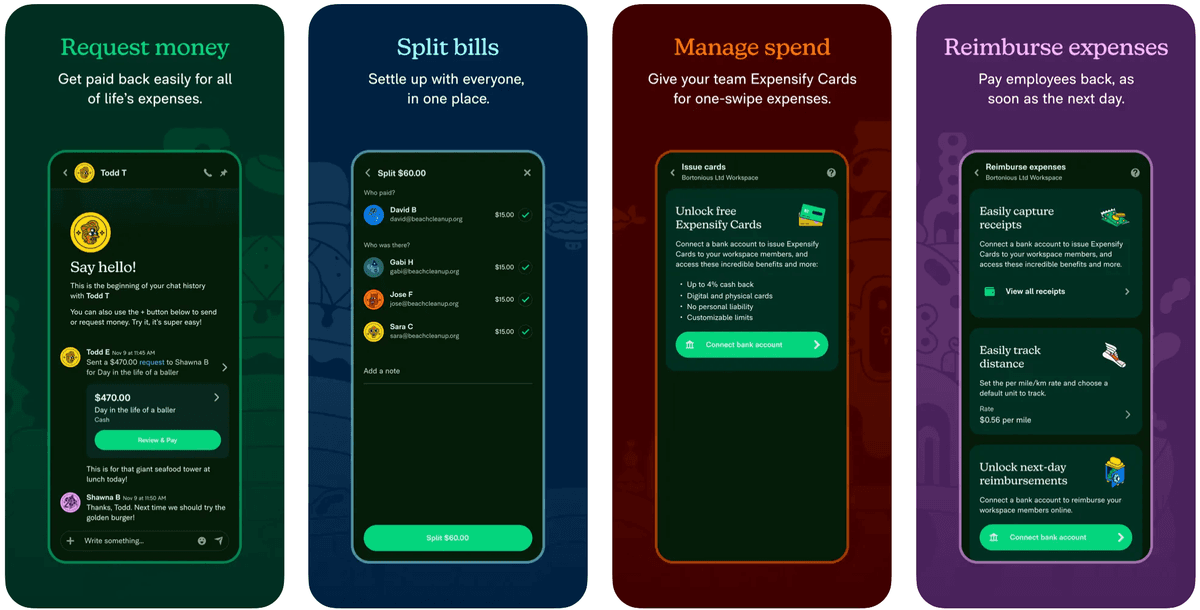
Hiring me for Python backend development — APIs, data pipelines, integrations, and the infrastructure underneath them — typically runs $20K–$120K depending on whether you need a focused service built or a full production backend from scratch. I bring 7+ years of production delivery, including work as a Guest Engineer at Expensify on an expense platform used by millions, and I'm Top Rated on Upwork with $100K+ earned and verified client reviews — though Upwork is just one channel, and I work directly with founders and CTOs worldwide. Engagements start with a short scoping phase that produces a fixed plan, so you know what ships and when before the bulk of the budget is committed.
A backend is the part of your product users never see and never forgive. If your API is slow, your data pipeline silently drops records, or your one backend developer just left, you don't need more code — you need someone who has kept production systems alive and knows which corners are safe to cut.
Weekly demos, async Slack updates, production standards.
04
Ship
Store launch, documentation, knowledge transfer.
Engagements this covers
Backend for a mobile product hitting scale
A funded startup's app is growing, but the Firebase-and-glue backend behind it is failing under load and blocking features. I design and build a Python API with proper authentication, background jobs, and a migration path off the old stack — executed incrementally so the app never goes down. The team ships features again instead of firefighting, and the backend has room to grow.
Data pipeline replacing a spreadsheet operation
An operations company runs its business on exports, manual joins, and a nightly ritual of copy-paste. I build a pipeline that ingests from their SaaS tools and partners, validates and reconciles the data, and lands it in a warehouse with alerting when sources break. Reports that took a day of manual work become dashboards that are simply correct every morning.
Rescue of a stalled backend project
A founder inherited a half-finished Django codebase from a departed agency: no tests, no deployment story, features that work only on the original developer's laptop. I audit what's salvageable, stabilize deployment first, then rebuild the weakest components while keeping the product running. Within weeks there's a CI pipeline, a staging environment, and a codebase a future hire can actually join.
What the engagement looks like week by week
Week 1 is scoping and architecture: we turn your goals into a concrete technical plan — endpoints, data model, infrastructure, third-party integrations — and I flag the decisions that are expensive to reverse later. You get this plan in writing whether or not we continue, because a backend built without one is a rebuild waiting to happen. Weeks 2–4 build the skeleton end to end: a deployed API with authentication, the core data model, CI/CD, and one or two real features running in a staging environment your team can hit.
From week 5 onward the rhythm is weekly, visible increments: features land in staging, you review against real behavior rather than status updates, and priorities can shift between weeks without renegotiating the contract. Projects at the $20K–$40K end wrap in six to eight weeks; larger builds run three to five months with the same cadence. The final weeks always include load testing on realistic traffic, monitoring, runbooks, and handover sessions with whoever operates it after me.
What drives cost inside the $20K–$120K range
The low end covers a well-defined single service: one API or pipeline, a clean data model, standard authentication, deployed with CI/CD and monitoring. Cost rises with the number of external systems you integrate — every third-party API brings its own failure modes, rate limits, and webhooks that must be handled, not hoped away — and with data complexity: multi-tenant models, financial data needing audit trails, or migrations from a legacy system that must run without downtime.
The top of the range is full production platforms: multiple services, background job infrastructure, real-time features, compliance requirements, and load profiles that demand actual capacity planning. Two multipliers deserve honesty up front. Uptime expectations — a backend that can tolerate an hour of downtime is much cheaper than one that can't — and the state of any existing code I must build against, since working around a fragile legacy system often costs more than the new code itself. I quote after the scoping week, not before.
Red flags when buying backend development
The most expensive red flag is a developer who starts coding before asking about your data. The data model is the foundation everything else stands on; someone who doesn't probe how your entities relate, what must be unique, and what happens on deletion is building on sand. Second: no deployment story until 'the end.' If working software isn't running in a staging environment by week three or four, you have no evidence anything works — demos on a laptop are not evidence.
Also be wary of framework zealotry in either direction: someone rewriting your functioning Django app in the year's fashionable stack is spending your money on their resume, while someone forcing every problem into the one framework they know will fight the problem instead of solving it. Finally, watch how they talk about failure. A backend developer who never mentions timeouts, retries, idempotency, or what happens when the third-party API goes down has never carried a pager, and it will show in production.
How to evaluate any vendor, including me
Ask to see something they've shipped that's still running, and ask what broke in production and how they found out. The answer reveals more than any portfolio: engineers who have operated their own systems talk about monitoring, migrations, and the incident that taught them idempotency; those who haven't talk only about features. Ask how they'd structure your specific problem — a competent backend engineer will sketch a data model and ask sharp questions within minutes, not deliver a generic pitch.
Then test the working relationship cheaply: a paid one-week scoping engagement shows you their communication, the quality of their written thinking, and whether their architecture plan makes sense to your other technical advisors. Check that they write things down — decisions, tradeoffs, runbooks — because a backend that lives only in one person's head is a liability you're paying to create. And confirm ownership explicitly: code, infrastructure accounts, and credentials should be in your name from day one.
What good delivery looks like
At handover, the system runs in your cloud account, under your billing, with your team holding every credential — my access can be revoked in five minutes without breaking anything. There's a CI/CD pipeline that runs the test suite and deploys on merge, a staging environment that mirrors production, and database migrations that run automatically rather than as folklore. The test suite covers the paths that lose you money when they break: authentication, payments, data ingestion — meaningful coverage, not a vanity percentage.
Operationally, you get monitoring with alerts routed somewhere humans look, structured logs that make 3 a.m. debugging survivable, and short runbooks for the failures that will eventually happen: a stuck queue, a failed migration, a third-party outage. Documentation covers why decisions were made, not just what exists. The real test of good delivery is boring: the next engineer who joins can set up locally in under an hour, ship a small change in their first week, and never need to ask me anything.
When you should not buy this
Don't hire backend development before you've validated demand. If you're pre-launch and your product could run on Supabase, Firebase, or a no-code stack for six months, do that — a custom backend built before product-market fit usually gets rebuilt anyway once you learn what the product actually is. Similarly, if your bottleneck is frontend polish, distribution, or sales, a better backend improves nothing a customer can see.
Don't buy a project when what you need is a hire. If you have continuous backend work stretching past a year and enough of it to keep someone busy full-time, recruit a full-time engineer; a contractor is the wrong shape for that, and I'll tell you so in the scoping call. And if your current backend mostly works but feels untidy, resist the rewrite instinct — targeted refactoring at a fraction of the cost usually beats a rebuild, and a rebuild sold to you without profiling data is a red flag from anyone, including me.
Low-risk to start
✓Fixed-scope proposal first
You approve milestones and a price before any build starts — no open-ended hourly surprises.
✓Working demos every week
You see running software each week, not status reports, so you can course-correct early.
✓One senior owner, no hand-offs
The person who scopes the work is the person who builds it — no junior layers, no agency markup.
✓A track record you can verify
Top Rated on Upwork with public client reviews and $100K+ earned, plus contributions to Expensify. Check the receipts before you commit.
Which Python stack do you use, and what if our existing code uses something else?
For new builds I default to FastAPI or Django depending on the shape of the product — Django when you need its admin, auth, and ORM batteries; FastAPI for API-first services — with PostgreSQL underneath unless your data argues otherwise. But I work in your existing stack rather than around it: Flask, Celery, SQLAlchemy, serverless functions, whatever is there. Rewriting a working codebase to suit my preferences would be spending your money on my comfort.
Who maintains the backend after you deliver it?
Your choice, and we plan it before the build starts. Some clients have engineers who take over — for them, handover includes pairing sessions and documentation aimed at a fast transfer. Others keep me on a small monthly retainer covering monitoring, dependency updates, and incremental features. Either way the system is built to be maintainable by someone who isn't me: standard stack choices, tests, runbooks, and no clever code that requires its author present.
Can you work alongside our existing developers rather than solo?
Yes, and it's often the best-value setup: I take the architecture and the hardest backend problems while your team builds features alongside, absorbing the patterns as we go. I fit into your existing process — your repo, your code review, your standups if you have them. The goal in that mode is explicitly to make your team stronger after I leave, which is cheaper for you than renting my hands indefinitely.
How much does python backend development typically cost?
Projects typically fall in the $20K–$120K range depending on scope, integrations, and timeline. I provide a fixed-scope proposal after a 30-minute scoping call.
How long does a python backend development project take?
MVPs often ship in 8–12 weeks. Production systems with AI backends or RAG may run 12–20 weeks. Rescue and audit engagements can start within days.
Do you work with startups and enterprises?
Yes. I work with founders, CTOs, product teams, and agencies worldwide — US, UK, EU, and APAC time zones with async updates and weekly demos.
Can you own mobile and backend together?
Yes. I specialize in React Native + Python (FastAPI) + AI (RAG, agents, OpenAI/Claude) under one senior owner — fewer handoffs, faster shipping.
How do I get started?
Book a free 30-minute scoping call on this site, hire through Upwork, or email dhairyasenjaliya@gmail.com with your brief and timeline.