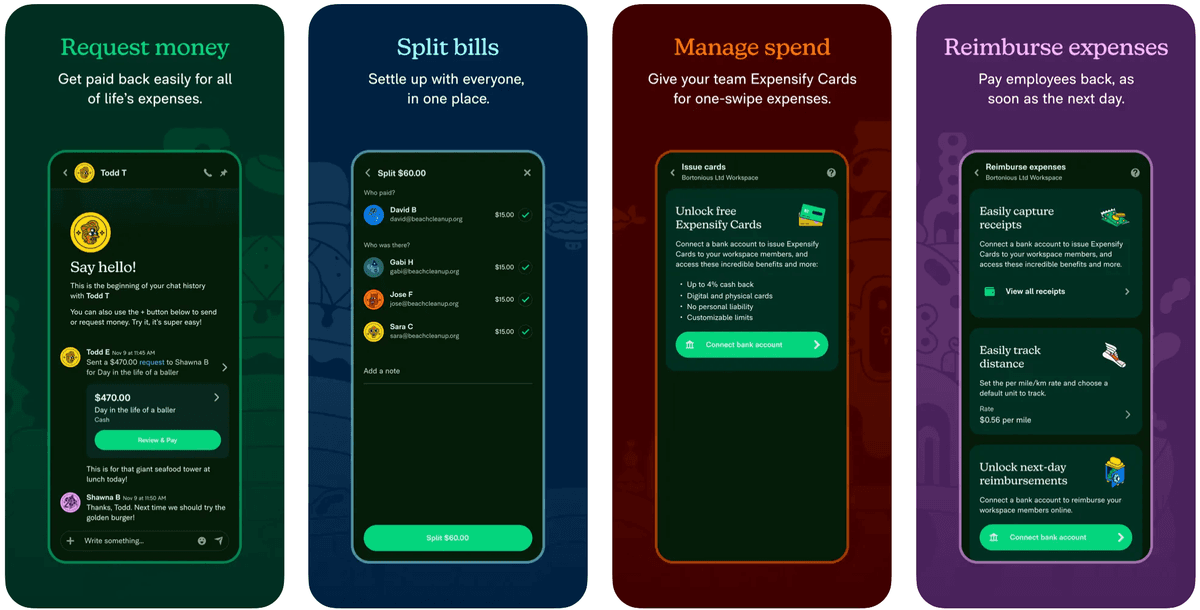
I take on Python development engagements — backends, APIs, data pipelines, automation, and AI integrations — in the $25K–$150K range: a focused production service at the low end, a multi-month build of a company's core backend at the high end. I've written production Python for 7+ years, I'm Top Rated on Upwork with $100K+ earned and verified client reviews, and I've shipped as a Guest Engineer at Expensify on software used by millions of users. Most clients engage me for 2–6 months, and the deliverable is always a system your own team can run and extend, with tests, CI, and documentation as defaults rather than extras.
Python is the language where a prototype most easily masquerades as a product — dynamic typing and quick scripts get you to a demo fast, and to a 3 a.m. outage almost as fast. This service is production Python: typed, tested, deployed, and observable, whether that's a FastAPI backend, a data pipeline, or the service layer behind an AI product. Success depends on engineering discipline applied early, when it's cheap.
Weekly demos, async Slack updates, production standards.
04
Ship
Store launch, documentation, knowledge transfer.
Engagements this covers
Backend for a growing product
A funded startup needs its core API built properly — the founder-written prototype can't take more features. I design and build a FastAPI or Django backend with typed models, migrations, background jobs, and CI/CD, then hand it to their first engineering hires with documentation and a walkthrough. The company gets a foundation that survives its next two years of feature growth.
Data pipeline consolidation
An operations-heavy business runs on cron jobs and scripts written by four different people over four years; nobody trusts the numbers. I consolidate the flows into an orchestrated pipeline with validation between stages, idempotent runs, and alerting on anomalies. Reports that were quietly wrong become auditable, and the weekly firefight around data becomes a monitored system.
Python service layer for an AI product
A team shipping an LLM-powered product needs the unglamorous machinery around the model: request queueing, rate-limit handling, caching, cost tracking, evaluation jobs, and clean APIs for their frontend. I build that layer with the same rigor as any backend — because in production AI products, the Python around the model is where reliability is actually won or lost.
How I run a Python engagement
Week one produces two artifacts: a written technical plan (architecture, data model, integration points, deployment target) and a walking skeleton — the thinnest possible slice deployed to real infrastructure with CI running. That skeleton matters more than it looks: it forces every unpleasant surprise about your environment, access, and deployment to happen in week one instead of week nine.
From there, delivery is iterative and visible: working software lands in your staging environment continuously, not in a big handoff. I write typed Python (mypy or pyright enforced in CI), tests that cover behavior rather than chasing a coverage number, and structured logging from the start. The final phase of any engagement is deliberately about leaving: documentation, runbooks, dependency update strategy, and pairing sessions with whoever inherits the code. My definition of done is that your team deploys a change without me — I measure that before I consider the engagement complete.
What drives cost across a $25K–$150K range
The range is wide because 'Python development' spans very different projects. The primary driver is surface area: one well-scoped service or pipeline sits at $25K–$50K; a product's entire backend — auth, billing hooks, background processing, admin tooling, integrations — runs $80K–$150K over several months. Integration count is the second driver; every third-party system (payments, CRMs, legacy databases, partner APIs) brings its own auth quirks, failure modes, and testing burden.
Third is operational bar. An internal tool that can fail during business hours costs less than a customer-facing system that needs high availability, on-call runbooks, and load testing. Data-intensive work adds its own axis — pipelines are priced by source messiness and correctness requirements more than data volume. What doesn't meaningfully drive cost: framework choice. FastAPI versus Django is a fit decision I'll make with you in week one, not a budget line.
Red flags when hiring Python developers
Python's approachability is a double-edged sword for buyers: the talent pool is enormous and the variance is brutal. The most common failure I'm hired to clean up is the fluent-but-unstructured codebase — thousands of lines that work until they don't, with no types, no tests, and business logic braided through everything, written quickly by someone who had never operated software. It demos identically to production-grade work, which is exactly the trap.
Concrete red flags: a candidate who can't explain how their last project was deployed and monitored (they wrote code, someone else ran it); portfolios that are all notebooks and scripts with no long-lived services; resistance to type hints in 2026; and estimates with no mention of testing or deployment, which means those are unpriced and will be skipped. One more: anyone who commits to rebuilding your system without reading its code first. Rewrites have their place, but recommending one sight-unseen is a sales tactic, not judgment.
What good delivery looks like
At the end of a well-run Python engagement, you should hold four things. First, a system in production — not a repo that 'just needs deployment,' which is a project that's 70% done and stalled. Second, a codebase your next hire can navigate: typed, consistently structured, with a README that gets a new developer to a running local environment in under an hour. Third, operational visibility — logs you can search, metrics on the endpoints and jobs that matter, and alerts tuned so they fire rarely and mean something.
Fourth, and least common in this market: an owner. Code without a designated owner inside your company decays regardless of quality, so part of my handoff is working with whoever inherits the system until they've shipped changes themselves. If you're hiring any vendor for Python work, put these four in the contract. They're cheap to promise, revealing to demand, and they separate production engineers from prototype authors within one conversation.
When custom Python development is the wrong spend
If your need is covered by a mature SaaS product at a few hundred dollars a month, buying beats building by an order of magnitude once you count maintenance — custom software is a liability you staff forever, not an asset that sits there. If your process is still changing weekly, automate it with spreadsheets and no-code tools until it stabilizes; codifying a moving target buys you rework, not leverage.
And if you can't name who inside your company will own the system after handoff, pause. I can make handoff smooth, but I can't make an unowned system survive. The best-fit buyers for this service have a validated need, a process or product worth encoding, and someone to inherit the result — in that situation, senior Python work compounds for years and is among the highest-leverage money a company spends. Outside it, I'd rather point you to the cheaper answer.
Low-risk to start
✓Fixed-scope proposal first
You approve milestones and a price before any build starts — no open-ended hourly surprises.
✓Working demos every week
You see running software each week, not status reports, so you can course-correct early.
✓One senior owner, no hand-offs
The person who scopes the work is the person who builds it — no junior layers, no agency markup.
✓A track record you can verify
Top Rated on Upwork with public client reviews and $100K+ earned, plus contributions to Expensify. Check the receipts before you commit.
How much does it cost to hire a senior Python developer for a project?
Project-based engagements with a senior freelance Python engineer typically run $25K–$150K. A single production service — an API, a pipeline, an integration layer — lands at $25K–$50K over 4–8 weeks. Full product backends built over several months occupy the $80K–$150K range. Hourly-equivalent rates for senior Python talent generally sit between $80 and $180; the meaningful comparison is total cost to a production system, including testing, deployment, and handoff.
Should I use Python or Node.js for my backend?
Both run production backends well, so decide on ecosystem fit. Python wins when your product touches data work, machine learning, or AI integrations — the libraries and model tooling live there — and FastAPI has erased the old performance argument for typical API workloads. Node makes sense when your team is TypeScript-end-to-end and shares code with the frontend. Team fluency beats benchmark charts: the stack your engineers can debug at midnight is the right one.
How long does a custom Python development project take?
A focused service — one API, one pipeline, one integration — takes 4–8 weeks to production including tests, deployment, and monitoring. A complete product backend runs 3–6 months. The honest schedule risks are rarely Python itself: they're access and decisions — credentials to third-party systems, undocumented legacy behavior, and pending product choices. I front-load all three in week one, which is the single most effective thing anyone can do to keep a software timeline.
How much does python development services typically cost?
Projects typically fall in the $25K–$150K range depending on scope, integrations, and timeline. I provide a fixed-scope proposal after a 30-minute scoping call.
How long does a python development services project take?
MVPs often ship in 8–12 weeks. Production systems with AI backends or RAG may run 12–20 weeks. Rescue and audit engagements can start within days.
Do you work with startups and enterprises?
Yes. I work with founders, CTOs, product teams, and agencies worldwide — US, UK, EU, and APAC time zones with async updates and weekly demos.
Can you own mobile and backend together?
Yes. I specialize in React Native + Python (FastAPI) + AI (RAG, agents, OpenAI/Claude) under one senior owner — fewer handoffs, faster shipping.
How do I get started?
Book a free 30-minute scoping call on this site, hire through Upwork, or email dhairyasenjaliya@gmail.com with your brief and timeline.