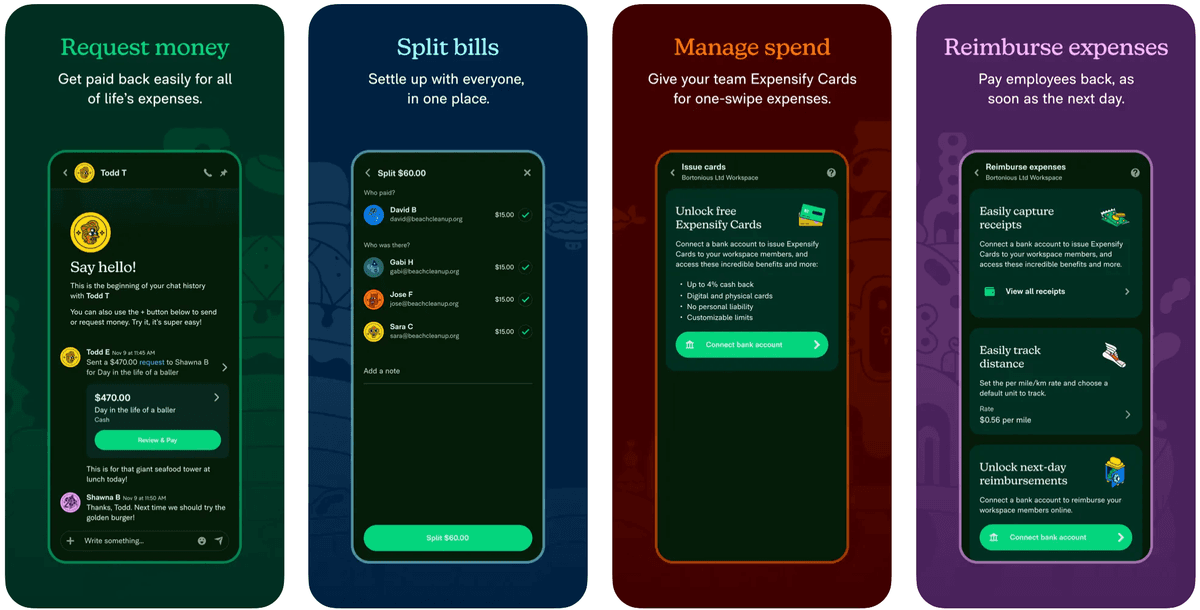
Hiring me for OpenAI development typically costs $15K–$100K: the low end covers integrating GPT models into an existing product with proper structured outputs and cost controls, while the high end covers full AI products with tool calling, evals, and production monitoring. I'm Top Rated on Upwork with $100K+ earned and verified client reviews, I've worked as a Guest Engineer at Expensify, and I've shipped apps used by millions of users. Engagements start with a scoping call and a fixed-price first milestone, so you see working software before committing the full budget.
Wiring your product to the OpenAI API takes an afternoon; making it accurate, fast, affordable, and safe in front of paying customers is the actual project. I build OpenAI-powered features the way I build any production system — with schemas, evals, fallbacks, and a cost model — so what demos well in week one still works at ten thousand users.
Weekly demos, async Slack updates, production standards.
04
Ship
Store launch, documentation, knowledge transfer.
Engagements this covers
Adding an AI feature to an existing SaaS
A B2B product wants a 'draft this for me' feature inside their existing app. I design the prompt and context strategy, enforce structured outputs so responses render reliably in their UI, add streaming for perceived speed, and instrument token spend per customer. The feature ships behind a flag, gets evaluated on real usage, and rolls out without surprising the infrastructure bill.
GPT-4-era prototype that needs to become a product
A founder has a prompt-heavy prototype that impresses in demos but breaks on edge cases and costs too much per request. I restructure it around function calling and validated JSON, build an eval suite from their real failure cases, route simple requests to cheaper models, and add rate limiting and abuse controls. The product becomes shippable at a per-user cost that survives their pricing.
Assistant that needs tools, not just chat
A company wants an assistant that actually does things — looks up orders, files tickets, updates records — not just answers questions. I build the tool-calling layer with strict schemas, permission checks on every action, and an audit trail of what the model did on whose behalf. Users get an agent that acts safely; the company gets logs they can defend.
What you're actually buying
The OpenAI SDK call is maybe two percent of the work. What you're paying for is everything around it: prompt and context design that survives real user input, structured outputs with validation so your UI never renders a malformed response, streaming so the feature feels fast, retries and fallbacks so an API blip doesn't become your outage, and an eval harness so you can change a prompt without guessing what broke.
You're also buying a cost model. I instrument token usage per feature and per customer from day one, because the difference between a profitable AI feature and a loss-making one is usually caching, prompt trimming, and routing easy requests to cheaper models — decisions that need data. Teams that skip this discover their unit economics from an invoice.
What drives cost inside the $15K–$100K range
A single feature inside an existing product — one prompt surface, structured output, streaming, basic monitoring — sits at the low end, around $15K–$30K. The middle of the range adds tool calling, multi-step workflows, an eval suite, and cost optimization. The top end is a full AI product: multiple model interactions, agent-style tool use with permissions and audit trails, fine-tuning or heavy prompt-caching work, and the admin tooling to operate it.
Two things quietly inflate budgets. First, accuracy requirements: moving a feature from 'usually right' to 'reliably right' means building evals and iterating against them, which is real engineering time. Second, data sensitivity: healthcare, legal, or financial contexts add redaction, logging policy, and compliance review. Neither is padding — they're the difference between a feature and a liability.
Red flags when hiring for OpenAI work
Be wary of anyone whose portfolio is entirely demos and tutorials — the gap between a Streamlit prototype and a production feature is where these projects die. Ask specifically what they've operated in front of paying users and what broke.
Watch for prompt-only thinking. If a candidate's answer to every quality problem is 'better prompting,' they'll hit a ceiling fast; production quality comes from structured outputs, validation, evals, and knowing when to change the architecture instead of the words. Also probe cost awareness: someone who can't estimate what a feature costs per thousand requests, or who defaults to the most expensive model for everything, will hand you a feature your margins can't support. Finally, avoid anyone dismissive of failure handling — the OpenAI API has rate limits, timeouts, and occasional bad outputs, and your users shouldn't be able to tell when it does.
How I keep model changes from breaking you
OpenAI ships new models and deprecates old ones on a cadence you don't control, and behavior shifts between versions even when the API stays compatible. I build every project so a model swap is a config change plus an eval run, not a rewrite: prompts versioned in code, outputs validated against schemas rather than parsed by hope, and a test set of real cases that scores any candidate model before it touches production.
This matters commercially, not just technically. Newer models are frequently cheaper and better, and teams with an eval harness adopt them in a day and pocket the savings; teams without one stay pinned to an aging model because nobody can say what an upgrade would break. Part of every engagement is leaving you with that harness and the documentation to run it yourself.
When you don't need OpenAI development
If your task is deterministic — parsing well-formed data, matching against a fixed list, arithmetic on known fields — you don't need a model, and I'll tell you so in the first call. Regex and a database query are faster, free, and never hallucinate. I've talked more than one buyer out of an LLM feature and into a two-day script.
You also may not need custom development if an off-the-shelf tool already nails your use case; generic chat-with-your-docs products are cheap now, and building bespoke only makes sense when the AI feature is core to your product or needs deep integration with your data and permissions. And if you don't yet have users, consider shipping the non-AI version first — the model layer is much easier to design once real usage tells you what people actually ask for.
Low-risk to start
✓Fixed-scope proposal first
You approve milestones and a price before any build starts — no open-ended hourly surprises.
✓Working demos every week
You see running software each week, not status reports, so you can course-correct early.
✓One senior owner, no hand-offs
The person who scopes the work is the person who builds it — no junior layers, no agency markup.
✓A track record you can verify
Top Rated on Upwork with public client reviews and $100K+ earned, plus contributions to Expensify. Check the receipts before you commit.
How much does it cost to build an app with the OpenAI API?
Integrating an OpenAI-powered feature into an existing product typically costs $15K–$30K including structured outputs, streaming, and monitoring. A full AI product with tool calling, evals, and cost optimization runs $50K–$100K. Separately, budget for ongoing API usage — anywhere from tens of dollars to thousands per month depending on volume — which is exactly why per-request cost modeling is part of the build.
How long does an OpenAI integration project take?
A single production-grade feature usually takes three to six weeks: prompt and schema design, integration with streaming and error handling, an eval pass on real inputs, then a flagged rollout. Larger builds with tool calling and multiple surfaces run two to four months. I ship in milestones, so you have something clickable within the first two weeks rather than waiting for the end.
Should I use GPT models via the API or build with open-source LLMs?
Start with the OpenAI API in almost every case: no infrastructure to run, strong models immediately, and you learn what quality bar your use case actually needs. Open-source self-hosting makes sense later, if volume gets high enough that per-token costs dominate or if data can't leave your infrastructure. I design the integration so the model layer is swappable, which keeps that door open without paying for it up front.
How much does openai development services typically cost?
Projects typically fall in the $15K–$100K range depending on scope, integrations, and timeline. I provide a fixed-scope proposal after a 30-minute scoping call.
How long does a openai development services project take?
MVPs often ship in 8–12 weeks. Production systems with AI backends or RAG may run 12–20 weeks. Rescue and audit engagements can start within days.
Do you work with startups and enterprises?
Yes. I work with founders, CTOs, product teams, and agencies worldwide — US, UK, EU, and APAC time zones with async updates and weekly demos.
Can you own mobile and backend together?
Yes. I specialize in React Native + Python (FastAPI) + AI (RAG, agents, OpenAI/Claude) under one senior owner — fewer handoffs, faster shipping.
How do I get started?
Book a free 30-minute scoping call on this site, hire through Upwork, or email dhairyasenjaliya@gmail.com with your brief and timeline.