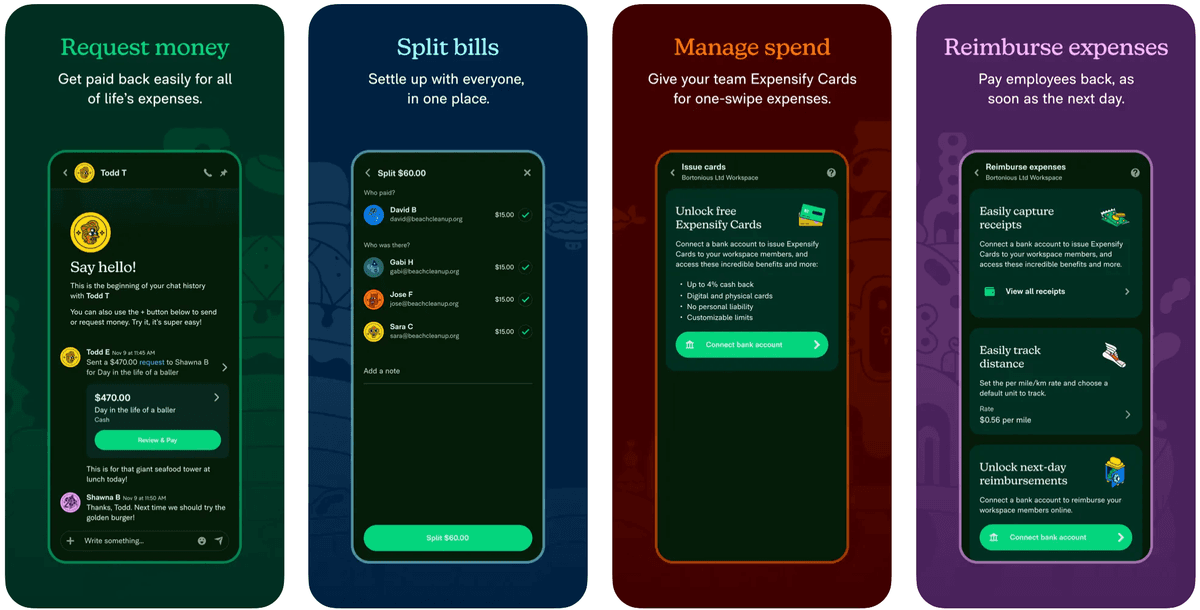
I take generative AI features from idea to production — drafting tools inside SaaS products, high-volume content pipelines, and agentic workflow automation — with engagements typically running $25K–$150K depending on output volume, quality bar, and integration depth. My background is 7+ years of production delivery on apps used by millions of users, including work as a Guest Engineer at Expensify. Most features reach a usable internal version within a month, with the rest of the timeline spent closing the gap between a good demo and something customers rely on daily.
The distance between a generative AI demo and a feature customers trust is where most of these projects die: the demo works on ten curated inputs, while production means acceptable quality on the messy ninety-fifth percentile. This service exists to close that gap — with measurement, human review where it belongs, and cost engineering — so the feature ships and stays shipped.
Weekly demos, async Slack updates, production standards.
04
Ship
Store launch, documentation, knowledge transfer.
Engagements this covers
A drafting feature inside your SaaS
A B2B product wants to generate first drafts — emails, reports, summaries — from data users already have in the app. I build the generation pipeline, the editing UX around it, and the instrumentation showing how often users accept, edit, or discard drafts. That acceptance rate becomes the number we improve release over release.
Content generation at catalog scale
An e-commerce or marketplace team needs thousands of product descriptions or listings that follow brand rules and don't read as machine sludge. I build a pipeline with structured inputs, style constraints, automated quality checks, and a human review queue for the fraction that needs eyes. Output volume rises an order of magnitude without the brand degrading.
Agentic automation for a back-office process
A team burns hours daily on a multi-step process — triaging inbound requests, categorizing them, drafting responses, updating systems. I build an agent that runs the sequence with checkpoints where a human approves anything irreversible. The team shifts from doing the process to reviewing it, and throughput stops being limited by headcount.
Scoping: picking the workflow that pays for itself
Generative AI projects succeed or fail at selection, before any code exists. The right first workflow has three properties: high volume (so quality effort amortizes), measurable output (you can say concretely what 'good' means), and tolerance for review (a human can catch a bad output before it causes damage). Drafting, summarization, categorization, and structured extraction usually qualify. One-off creative work, high-stakes legal language, and anything where a single bad output is catastrophic usually don't — at least not as the first project.
Week one of any engagement with me is building this case honestly: what the output is, who reviews it, what it replaces, and what number tells us it worked. If the numbers don't support the build, I'll say so then, when it's cheap to hear.
How the build unfolds
The first two weeks produce two artifacts: a golden set of real inputs with known-good outputs, and a first pipeline version scored against it. Scoring from day one changes everything downstream — every prompt change, model swap, and pipeline tweak becomes a measured decision instead of a debate.
Weeks three through six integrate the pipeline into your product: the review-and-edit interface, the queue for outputs that fail automated checks, and instrumentation on what users do with what's generated. The remainder is a hardening loop driven by real usage — expanding the golden set with production failures, tightening cost per output, and handling the input weirdness no test set predicts. Rollout goes cohort by cohort, because generative features earn trust gradually and lose it instantly.
What moves cost inside $25K–$150K
The low end covers one output type, freeform text, generated inside an existing product surface with light review tooling. Each of these pushes the number up: additional output types (each needs its own evaluation and prompt engineering), structured outputs that must validate against a schema, multi-step agent workflows where errors compound across steps, tight latency requirements that force streaming and caching architecture, and multimodal inputs or outputs.
The cost driver buyers underestimate is review tooling. If humans approve outputs, the queue interface, keyboard-speed workflows, and feedback capture are real product engineering — often a third of the budget — but they're also what makes the system improve over time instead of plateauing. The cost driver buyers overestimate is model fees, which for most B2B volumes are hundreds of dollars a month, not thousands.
The demo-to-production gap, specifically
A demo proves the model can produce a good output. Production requires that the ninety-fifth percentile of outputs — on inputs you didn't curate — stays above your quality floor, at a cost and latency you can live with, without leaking prompts or being manipulated by user-supplied content. Those are four separate engineering problems and none of them appear in a demo.
Concretely, closing the gap means: automated output validation before anything reaches a user, injection-resistant handling of user content that flows into prompts, per-feature cost ceilings with caching underneath, drift monitoring so a silent model update doesn't degrade you, and a kill switch. This is the actual work of generative AI development. The prompt that impressed everyone in the demo is maybe five percent of it.
How to evaluate a generative AI developer
Ask what fraction of outputs needed human correction on their last shipped feature — a builder who has operated one in production knows this number, and someone who has only built demos will pivot to talking about models. Ask how they'd detect quality degrading after launch; the answer should involve a monitored eval set, not user complaints. Ask what the feature costs per thousand outputs and how they'd cut that in half; caching, model routing, and prompt economy should come up immediately.
Finally, ask what they've shipped that users touch daily. Notebooks and prototypes are fine credentials for research roles. For a product feature, you want someone who has lived through the support tickets, the edge cases, and the model deprecation mid-project.
When generative AI is the wrong tool
If the transformation is deterministic — same input structure, same output structure, every time — templates and code are cheaper, faster, and never hallucinate. If output variance is unwanted (invoices, compliance text, anything regulated), generation adds risk without adding value. And if a single wrong output creates unbounded liability, keep a human owning the final artifact and let AI accelerate the draft, not sign it.
There's also a timing question. If your input data is scattered and unstructured, spending the first budget on the data pipeline often beats bolting generation onto chaos — you'll need that work anyway, and generation quality rises directly with input quality. I've steered buyers away from generative builds toward data cleanup more than once, and the projects that came back later were better for it.
Low-risk to start
✓Fixed-scope proposal first
You approve milestones and a price before any build starts — no open-ended hourly surprises.
✓Working demos every week
You see running software each week, not status reports, so you can course-correct early.
✓One senior owner, no hand-offs
The person who scopes the work is the person who builds it — no junior layers, no agency markup.
✓A track record you can verify
Top Rated on Upwork with public client reviews and $100K+ earned, plus contributions to Expensify. Check the receipts before you commit.
Production generative AI features typically run $25K–$150K. A single drafting or summarization feature inside an existing product lands near the low end; multi-step agent workflows, structured generation with strict validation, or high-volume pipelines with human review tooling reach the upper end. Model API fees after launch are usually a minor line item compared to the engineering.
How long does it take to ship a generative AI feature?
A measured internal version typically exists within 3–4 weeks. Production — with output validation, review workflows, cost controls, and a staged rollout — is usually 8–16 weeks depending on how deeply the feature integrates into your product. The stretch between demo and launch is where the real engineering happens, so compress it with caution.
Should I wait for better models instead of building now?
No — the durable work isn't model-dependent. Your evaluation sets, data pipelines, review workflows, and product integration all carry forward when models improve; teams that build them now get compounding gains from every model release, while teams that wait start from zero later. Build so the model is a swappable component, which is how I architect these systems by default.
How much does generative ai development typically cost?
Projects typically fall in the $25K–$150K range depending on scope, integrations, and timeline. I provide a fixed-scope proposal after a 30-minute scoping call.
How long does a generative ai development project take?
MVPs often ship in 8–12 weeks. Production systems with AI backends or RAG may run 12–20 weeks. Rescue and audit engagements can start within days.
Do you work with startups and enterprises?
Yes. I work with founders, CTOs, product teams, and agencies worldwide — US, UK, EU, and APAC time zones with async updates and weekly demos.
Can you own mobile and backend together?
Yes. I specialize in React Native + Python (FastAPI) + AI (RAG, agents, OpenAI/Claude) under one senior owner — fewer handoffs, faster shipping.
How do I get started?
Book a free 30-minute scoping call on this site, hire through Upwork, or email dhairyasenjaliya@gmail.com with your brief and timeline.