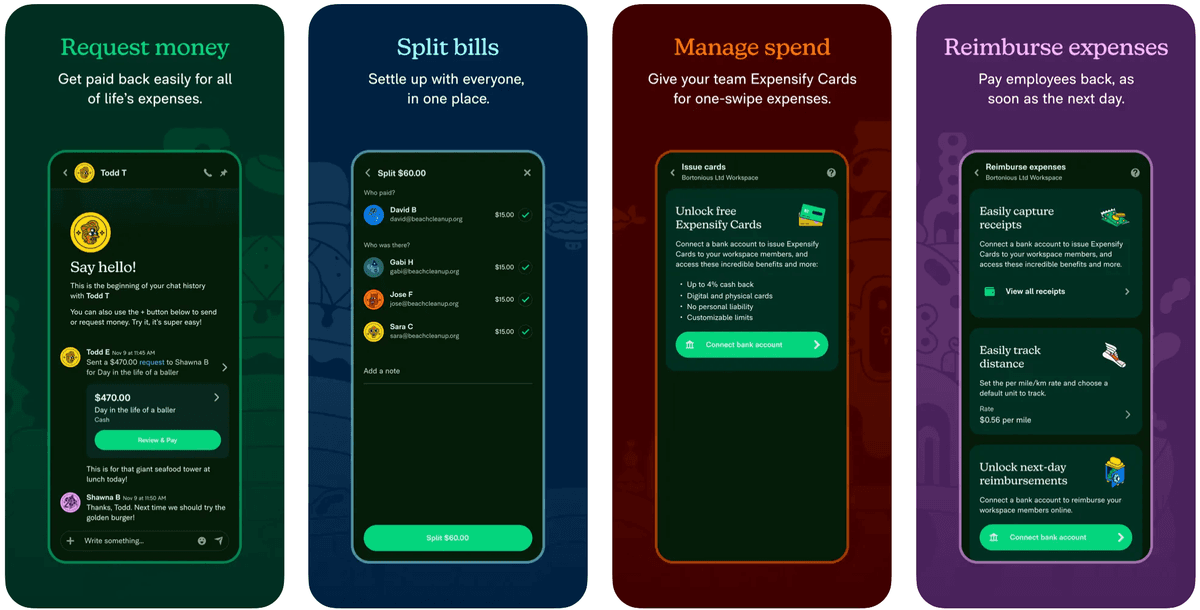
AI workflow automation projects with me typically run $15K–$80K depending on how many workflows we automate and how much human review the output needs. I'm a Guest Engineer at Expensify and Top Rated on Upwork with $100K+ earned and verified client reviews, and I bring 7+ years of production delivery to every engagement. Hiring starts with a short scoping conversation where we pick one painful, high-volume workflow, and I ship a working automation of it before we commit to the full roadmap. Most first automations are live in production within four to six weeks.
Your team is spending hours a day on work a model can do in seconds — triaging tickets, extracting data from documents, drafting responses, reconciling records. The hard part isn't calling an LLM; it's building the guardrails, review queues, and failure handling that make automation trustworthy enough to actually remove the human from the loop.
Weekly demos, async Slack updates, production standards.
04
Ship
Store launch, documentation, knowledge transfer.
Engagements this covers
Document intake that eats an ops team
A logistics company receives hundreds of PDFs and emails daily — invoices, customs forms, delivery confirmations — all keyed in by hand. I build an extraction pipeline with confidence scoring: high-confidence records flow straight into their system, low-confidence ones land in a review queue. Manual entry drops to a fraction of its former volume within the first month.
Support triage before the first human touch
A SaaS company's support inbox mixes bugs, billing questions, and churn risks in one undifferentiated pile. I build a classification and drafting layer that tags severity, routes to the right owner, and pre-writes a suggested reply with sources. Agents approve or edit rather than compose from scratch, and first-response time falls dramatically.
Internal reporting nobody wants to write
An agency compiles weekly client reports by copying numbers from five tools into slide decks. I wire their data sources into a pipeline that drafts each report, flags anomalies worth a human sentence, and posts it for review. The account team edits for ten minutes instead of assembling for three hours, and reports go out on time every week.
What an engagement looks like week by week
Week one is observation, not code. I sit with the people doing the workflow today, capture real inputs and outputs, and measure the current cost — how many items, how many minutes each, what the error rate already is. That baseline is what we judge the automation against, and most buyers skip it.
Weeks two through four, I build the first automation end to end: ingestion, the LLM step, validation, and a review queue for anything the system isn't sure about. It runs in shadow mode alongside the humans first, so we compare outputs before anything is trusted. From week five onward we widen the confidence thresholds, cut over the safe categories, and pick the next workflow. You see production value inside the first month, not at the end of a quarter.
What drives cost inside the $15K–$80K range
The single biggest cost driver is what happens when the model is wrong. A workflow where a bad output is annoying — a mislabeled ticket — needs light guardrails and lands near the bottom of the range. A workflow where a bad output costs money or breaks compliance — payments, contracts, anything customer-facing — needs validation layers, audit logs, and human-approval steps, and that engineering is most of the budget.
The second driver is integration surface. If your data lives in two systems with decent APIs, connecting them is quick. If it lives in email threads, scanned PDFs, and a legacy tool with no API, ingestion becomes its own project. Number of workflows matters less than you'd think; once the first pipeline and review infrastructure exist, each additional workflow is substantially cheaper.
Mistakes companies make buying automation
The most common mistake is automating the wrong workflow first — usually the most annoying one instead of the most measurable one. Start with a workflow that has clear volume, a clear per-item cost, and a tolerant failure mode, because that's where you can prove ROI in weeks and earn the political capital for harder targets.
The second mistake is buying a demo instead of a system. Anyone can show a model extracting fields from a clean sample document. Production means the blurry scan, the form in another language, the email with three attachments and contradictory data. If a vendor's proposal doesn't mention error handling, review queues, or what accuracy they'll commit to measuring, they're selling you the demo. The third mistake is aiming for 100% automation on day one; the teams that win run at 80% automated with a tight human loop on the rest.
How to evaluate anyone for this work
Ask a candidate how they'd measure whether the automation is working. A strong answer talks about baseline metrics, shadow-mode comparison against human output, and per-category accuracy — not model names. Ask what happens when the model returns garbage; you want to hear about schema validation, confidence thresholds, retries, and a queue for humans, in that order.
Also probe for ops empathy. The engineer needs to understand the workflow as your team actually performs it, including the exceptions they handle from memory. Someone who starts designing the pipeline before interviewing the people doing the job will automate a version of the process that doesn't exist. Finally, ask about cost: they should be able to estimate per-item inference cost and tell you when a cheaper model or plain regex beats the flagship model — because for a lot of steps, it does.
When you should not buy this
Don't automate a workflow that's still changing weekly. If the process itself isn't stable — the team is redefining categories, the upstream format shifts monthly — automation just hardens churn into code you'll rewrite. Stabilize the process manually first, then automate it.
Don't buy this for low-volume work either. If a task happens twenty times a month and takes five minutes, the math never works; a checklist is cheaper than a pipeline. And if your real problem is that nobody knows how the process works — tribal knowledge in one person's head — you need documentation before automation. I turn down engagements where the volume or stability isn't there, because a $15K build that saves two hours a month is a bad purchase, and you'd resent it within a quarter. The best automation targets are boring, high-volume, and well-understood.
Low-risk to start
✓Fixed-scope proposal first
You approve milestones and a price before any build starts — no open-ended hourly surprises.
✓Working demos every week
You see running software each week, not status reports, so you can course-correct early.
✓One senior owner, no hand-offs
The person who scopes the work is the person who builds it — no junior layers, no agency markup.
✓A track record you can verify
Top Rated on Upwork with public client reviews and $100K+ earned, plus contributions to Expensify. Check the receipts before you commit.
How much does AI workflow automation cost for a small business?
A single well-scoped workflow — one document type or one triage process with a review queue — typically lands at $15K–$30K and ships in four to six weeks. Multi-workflow programs with heavy integrations, audit requirements, or strict accuracy targets run $50K–$80K. Ongoing model and infrastructure costs are usually modest, often tens to a few hundred dollars a month at small-business volume.
How long does it take to automate a workflow with AI?
For a stable, well-understood workflow, expect a production-ready first automation in four to six weeks: one week of observation and baseline measurement, two to three weeks of build, then a shadow-mode period running alongside your team before cutover. Additional workflows go faster because the ingestion, validation, and review infrastructure already exists.
Should I automate with AI or hire another ops person?
Compare the math honestly. If the work is high-volume, repetitive, and tolerant of a review step, automation usually wins within months and scales without hiring again. If the work requires judgment on every item, changes constantly, or happens a few dozen times a month, a person is cheaper and more flexible. Many teams do both: automate the volume, redeploy the person to exceptions.
How much does ai workflow automation typically cost?
Projects typically fall in the $15K–$80K range depending on scope, integrations, and timeline. I provide a fixed-scope proposal after a 30-minute scoping call.
How long does a ai workflow automation project take?
MVPs often ship in 8–12 weeks. Production systems with AI backends or RAG may run 12–20 weeks. Rescue and audit engagements can start within days.
Do you work with startups and enterprises?
Yes. I work with founders, CTOs, product teams, and agencies worldwide — US, UK, EU, and APAC time zones with async updates and weekly demos.
Can you own mobile and backend together?
Yes. I specialize in React Native + Python (FastAPI) + AI (RAG, agents, OpenAI/Claude) under one senior owner — fewer handoffs, faster shipping.
How do I get started?
Book a free 30-minute scoping call on this site, hire through Upwork, or email dhairyasenjaliya@gmail.com with your brief and timeline.